
Building safety
São Paulo state law guarantees residents the right to install an electric car charger in their condominium parking space
State Law No. 18.403/2026 allows installing a charging station in the private parking space, with a qualified professional and an ART or RRT. The condominium may refuse only with a technical justification.
- The unit owner may install a charger in their private parking space, at their own expense.
- The installation requires a licensed professional, with an ART or RRT, and compliance with ABNT standards and the power utility's rules.
- Buildings with projects approved after the law must provide electrical capacity for charging.
By MTC Serviços editorial team2 min read
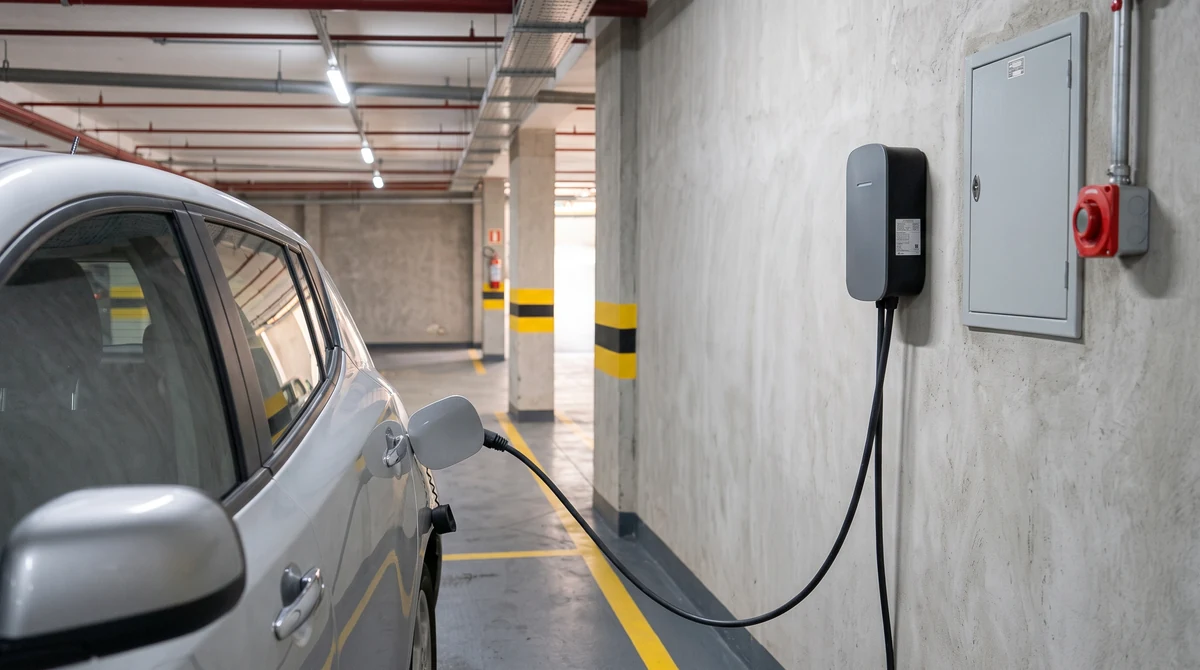
The State of São Paulo now guarantees condominium unit owners the right to install, at their own expense, an individual charging station for electric vehicles in their private garage space, in residential and commercial buildings. The rule is in State Law No. 18.403 of February 18, 2026, corrected in the Official Gazette (Diário Oficial) of February 20, and has been in force since publication.
What the installation requires
Under art. 1, the installation must be compatible with the unit's electrical load, follow the rules of the power utility and ABNT, be carried out by a licensed professional with an ART (engineer's Technical Responsibility Record) or an RRT (architect's equivalent), and be formally communicated to the condominium in advance.

The condominium's role
The condominium bylaws may set the form of communication, technical standards and responsibility for damages and for energy consumption. What they cannot do is prohibit the installation without a documented technical or safety justification. If the refusal is unjustified or discriminatory, the resident can take the matter to the competent public agencies.
For new buildings, art. 2 requires that projects approved after the law provide, in the electrical system, a minimum capacity for future charging stations. The technical details depend on regulation by the Executive Branch.
The Fire Department rules
At the Fire Department, the charging rules for garages are already in force. Ordinance CCB-003/970/2026, of March 17, 2026, added to Technical Instruction No. 41 the items on electric vehicle power supply systems. Responsibility for the installation lies with the technical manager or the installing company, which must follow ABNT standards NBR 5410, NBR 17019 and NBR IEC 61851-1.
The requirements include a dedicated circuit with a circuit breaker and a 30 mA residual-current device (DR) for each charger, surge protection, emergency shutdown points and a ban on charging the car from ordinary outlets, adapters or extension cords. In existing buildings, these items start to be checked at the renewal of the AVCB (Fire Department Inspection Certificate).
What this changes for you
- Before installing, ask a licensed professional to analyze the unit's electrical load and to issue the ART or RRT for the installation.
- Notify the condominium in writing and in advance, as the law requires.
- Building managers (síndicos) who intend to deny a request need a documented technical or safety justification.
- When the AVCB is renewed, the Fire Department will now check the installed chargers, under IT-41.
Want to know how this applies to your property or business? MTC reviews it before any proposal.
Chat on WhatsAppSources
- São Paulo State Legislative Assembly: Law No. 18.403 of February 18, 2026(opens in a new tab)
- State Official Gazette (Diário Oficial): Ordinance CCB-003/970/2026 (IT-41, electric vehicle charging)(opens in a new tab)
Informational text, based on official acts and publications. The ads on this page are for MTC's own services. To find out how this applies to your property or business, talk to the MTC technical team.