
Registry office · Property Registry
Out-of-court adverse possession (floor plan and descriptive report)
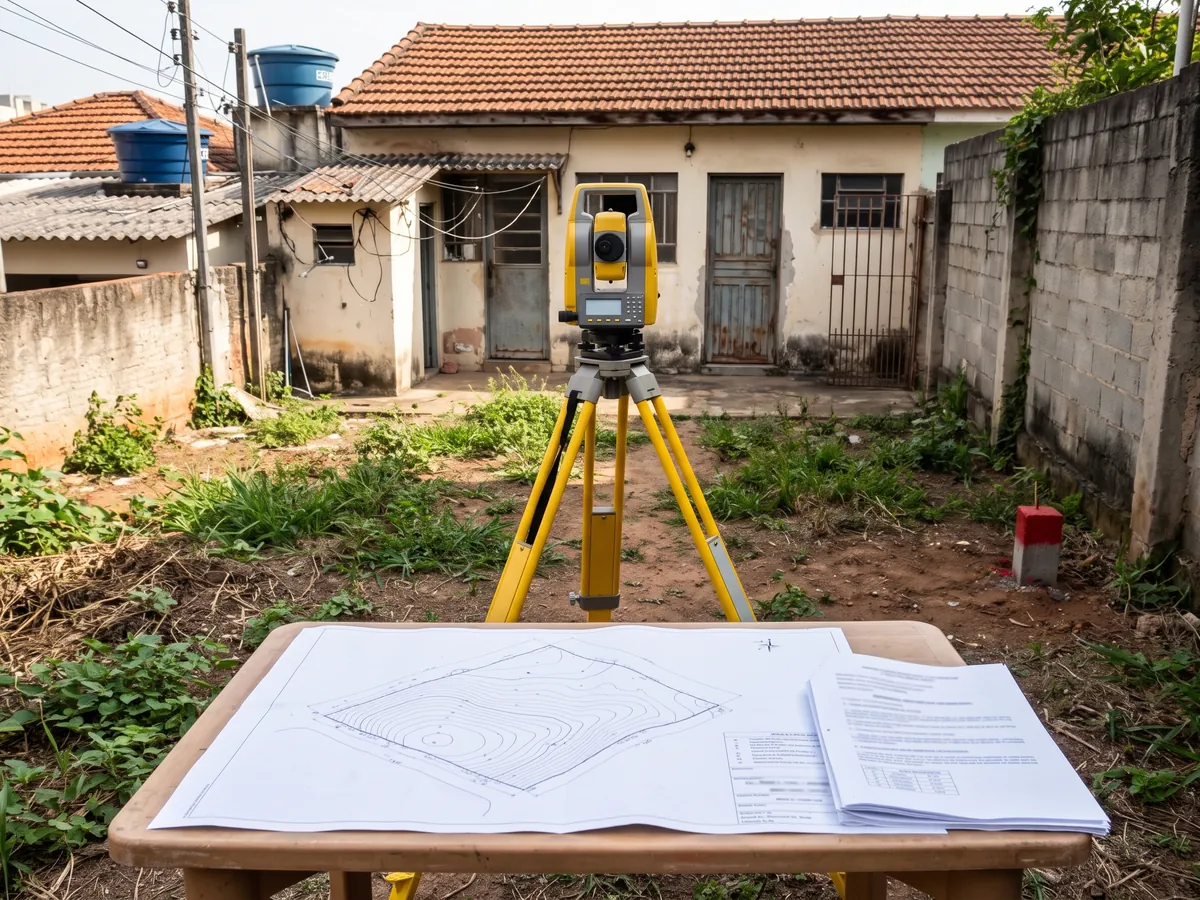
Survey, plan and descriptive memorial with an ART or RRT for adverse possession at the registry office, prepared together with your lawyer, from measuring the land to the technical requirements of the Property Registry.
Quick answer
Out-of-court adverse possession (floor plan and descriptive report) in São Paulo, in a few lines
Out-of-court adverse possession (usucapião extrajudicial) is the recognition of ownership for someone who has held possession for the period set by law, done directly at the Property Registry Office, without a court action. The application is filed by the lawyer and includes a notarial record, certificates, proof of possession and a plan and descriptive memorial signed by a licensed professional, with an ART or RRT. Neighbors and record holders who do not sign the plan are notified and have 15 days to respond. MTC does the technical part, from the survey to the plan and the descriptive memorial, and works together with the lawyer through to registration.
Updated on by the MTC technical team, based on the rules cited on this page.
- Who files the application
- A lawyer, at the local Property Registry Source: Public Records Law, Law No. 6.015/1973, art. 216-A (out-of-court adverse possession)(opens in a new tab)
- Plan and descriptive memorial
- Licensed professional, with an ART or RRT Source: CNJ National Code of Rules (Código Nacional de Normas), Provision No. 149/2023, arts. 398 to 423(opens in a new tab)
- Neighbor who did not sign
- 15 days; silence counts as agreement Source: Public Records Law, Law No. 6.015/1973, art. 216-A (out-of-court adverse possession)(opens in a new tab)
- If the registry office refuses
- A court action is still possible Source: Public Records Law, Law No. 6.015/1973, art. 216-A (out-of-court adverse possession)(opens in a new tab)
What out-of-court adverse possession is
Adverse possession (usucapião) is the way for someone who has held possession of a property, for the time and under the conditions set by law, to become the owner on the property record. Since 2016, it can also be recognized directly at the Property Registry Office, without a court case, when the documents are in order and no one objects.
Without the property record in your name, the property cannot be sold by deed, financed or safely divided among heirs, and it remains exposed to the debts of whoever is on the record. The application depends on technical documents: a plan and descriptive memorial signed by a licensed professional, with an ARTTechnical Responsibility Record (Anotação de Responsabilidade Técnica). A CREA record that identifies the engineer responsible for a project, technical report, or construction work. or RRTRRT (Technical Responsibility Record). The equivalent of the ART for architects, registered with the CAU., and by the neighbors along the boundaries. Anyone who does not sign is notified and has 15 days to respond.
What most often holds up the application is the technical part: measurements that do not match the property record, a boundary that encroaches on the neighbor, an adjoining owner who cannot be found. MTC carries out the survey and prepares the plan and the descriptive memorial with an ARTTechnical Responsibility Record (Anotação de Responsabilidade Técnica). A CREA record that identifies the engineer responsible for a project, technical report, or construction work. or RRTRRT (Technical Responsibility Record). The equivalent of the ART for architects, registered with the CAU., collects the adjoining owners' consent on the drawing and answers the registry office's technical requirements. The lawyer handles the application, and MTC works together with them.
What MTC does
Property survey
On-site measurement, boundaries, buildings and adjoining owners.
Plan and descriptive memorial
Technical documents with an ARTTechnical Responsibility Record (Anotação de Responsabilidade Técnica). A CREA record that identifies the engineer responsible for a project, technical report, or construction work. or RRTRRT (Technical Responsibility Record). The equivalent of the ART for architects, registered with the CAU., in the format the registry office requires.
Neighbors' consent
Adjoining owners' signatures on the plan, notarized.
Technical requirements
Plan adjustments and answers to the registry office's notes.
Understand it in one image
From possession to the property record in 5 stages
- 1
Possession proven
Length of possession and documents, reviewed with the lawyer.
- 2
Plan and descriptive memorial
Survey with an ART or RRT and the neighbors' signatures.
- 3
Notarial record and application
The notary attests to the possession; the lawyer files the application.
- 4
Notifications and public notice
Anyone who did not sign has 15 days; silence means agreement.
- 5
Property record in your name
With no objection, the registry office registers the adverse possession.
Need a lawyer? Yes: the lawyer files the application, and MTC prepares the plan and the descriptive memorial together with them.
What the registry office receives in the adverse possession application
The lawyer signs the application; MTC does the technical part.- 01 · Notarial recordLength and manner of possession, attested by the notary
- 02 · Technical documentsPlan and descriptive memorial with an ART or RRT
- 03 · CertificatesShowing no lawsuit against the possession, up to 30 days old
- 04 · Proof of possessionContracts, receipts, IPTU and old bills
Which adverse possession case is yours
Adverse possession at the registry office solves several document problems. The path changes depending on where the possession came from and on what is, or is not, on the property record.
1Bought with an unregistered private contract (contrato de gaveta), paid in full and the deed was never signed
In SP, a fully paid contract, with a court records certificate (certidão do distribuidor) showing no lawsuit over the property, counts as consent from the owner on the property record. The lawyer also assesses compulsory adjudication (adjudicação compulsória).
2The owner on the property record died and no one did the probate
The heirs can sign the plan with a declaratory deed of sole heirs (escritura declaratória de únicos herdeiros). Anyone who does not sign is notified and has 15 days to respond.
3The occupied area is larger than the one on the property record
If the difference is only in the measurements, within the boundaries, an area rectification may apply. If the possession goes beyond the title, adverse possession opens a new property record for the surveyed area.
4The property has no property record and no old registration
Adverse possession opens the property record. With no origin in the registry, the public notice says so and the plan needs at least 3 georeferenced points.
5It is a vacant lot, with no building
The possession must be confirmed by at least 2 witnesses, and the plan shows the boundaries that exist on site.
6It is an apartment in a building with a registered condominium
The plan and the descriptive memorial may be waived: the description on the property record applies, and the building manager is notified instead of the neighbors.
In every case, the application is signed by the lawyer. MTC does the technical part together with them and shows, in the survey, where the actual area differs from the property record.
Source: Rules of the São Paulo General Inspectorate of Justice (Corregedoria Geral da Justiça), Volume II, Chapter XX, items 416 to 425 (out-of-court adverse possession)(opens in a new tab)Why go through adverse possession
From undocumented possession to a property record in your name
Each card shows a common problem. Tap a problem to see how it is solved.
What happens when possession is left unregistered
Possession without a property record does not lead to a fine, but it keeps the property off the market and exposed. The more time passes, the harder it is to find the former owner, the heirs and the documents.
- 1
Undocumented possession
Purchase by contract, inheritance without an estate division or long-standing occupation, with nothing on the property record.
What can be doneKeep contracts, receipts, IPTU and bills from the start of the possession.
- 2
Former owner disappears
The record holder dies or moves away, and the heirs become hard to find.
What can be doneStart while neighbors and heirs can still sign the plan.
- 3
Objection at the registry office
A neighbor or record holder disputes the area, and the case may go to a judge.
What can be doneAn accurate plan and a conversation with the adjoining owners before the application.
- 4
Lawsuit
If the registry office rejects the application, a court action for adverse possession remains.
What can be doneTake the reviewed plan and descriptive memorial to the court action, with the lawyer.
Outside the registry office, the lack of registration weighs here
In business
- Sale by contract onlyThe buyer inherits the same problem.
- No financingThe bank requires the property record in your name.
In the family
- Probate stalledEstate division starts from what is registered.
- Record holder's heirsThey keep rights on the property record.
On the property
- Uncertain boundariesMeasurements no one has checked.
- Seizure for third-party debtsThe record holder's debts reach the property.
Have you lived for years in a property that is not in your name? Contact MTC and start with the technical part, together with your lawyer.
Chat on WhatsAppWhat adverse possession at the registry office brings
Property record in your name
The property becomes yours on the record.
No court case
With no objections, everything goes through the registry office.
Actual area registered
The property record comes out with the survey measurements.
Sale and financing
Property ready for a deed and for credit.
Inheritance in order
The property goes into the estate division with documentation.
Technical and legal work together
MTC on the plan, the lawyer on the application.
When it is needed
- Property bought with only a contract or receipt
- Seller who disappeared or died without signing the deed
- Owner on the property record deceased, with no probate
- Occupied area larger than the one on the property record
- Property without a property record
- Lawyer who needs the plan and the descriptive memorial
Documents that help you get started
You do not need all of them. The team will tell you what is missing.
- Property record or transcription (older registry entry), if any
- Contract, receipt or assignment of rights
- IPTU bills and old electricity and water bills
- Old plans, sketches or deeds
- Names and addresses of the neighbors along the boundaries
- Registry office's requirement note, if any
How we handle your case
- 1
Possession review
Property record, documents and length of possession, with the lawyer.
- 2
Survey
On-site measurement, boundaries and buildings.
- 3
Plan and descriptive memorial
Documents with an ART or RRT and the neighbors' signatures.
- 4
Registry office
Notarial record, the lawyer's application, notifications and public notice.
Property record in your name
Registration of the adverse possession with the surveyed area.
- The application is filed by a lawyer; MTC does the technical part together with them.
- Public property cannot be acquired by adverse possession.
- There are notary, registry office, notification and public notice costs.
- Adverse possession does not regularize the building at City Hall: that is a separate process.
Questions about Out-of-court adverse possession (floor plan and descriptive report)
The questions that come to the team and show up in searches most often, with the answer and the source.
See all questionsIt is the recognition of adverse possession directly at the Property Registry Office, without a court case. The application is filed by a lawyer, with a notarial record, a plan and descriptive memorial, certificates and proof of possession. With everything in order and no objection, the registry office registers the property in the possessor's name.
Source: Public Records Law, Law No. 6.015/1973, art. 216-A (out-of-court adverse possession) (opens in a new tab)It depends on the type. It is 15 years without title or good faith, or 10 if the possessor lives on the property or has carried out productive works on it; 10 years with just title and good faith; and 5 years for someone who lives in an urban area of up to 250 m² and owns no other property. The time of previous possessors can be added.
Source: Civil Code, arts. 1.238 to 1.243 (adverse possession of real property) (opens in a new tab)With documents from the whole period that show possession as an owner: IPTU, electricity, water and sewage bills, building or renovation expenses and old mail. Photos of the property and the dates of the buildings and improvements also count.
Source: TJSP: adverse possession, instructions for the initial petition (opens in a new tab)Yes. The law requires the application to be filed by a lawyer, who defines the type and signs the request. The plan and the descriptive memorial are prepared by a licensed engineer or architect, and MTC works together with the lawyer on this technical part.
Source: Public Records Law, Law No. 6.015/1973, art. 216-A (out-of-court adverse possession) (opens in a new tab)A legally qualified professional, such as an engineer or architect, with an ART or RRT at the professional council. The plan also carries the signatures of the holders on the property record and of the neighbors along the boundaries, notarized.
Source: Rules of the São Paulo General Inspectorate of Justice (Corregedoria Geral da Justiça), Volume II, Chapter XX, items 416 to 425 (out-of-court adverse possession) (opens in a new tab)Anyone who did not sign is notified by the registry office and has 15 days to respond; silence counts as agreement. If the person cannot be found, notice is given by public notice. A well-founded objection takes the case to a judge.
Source: Public Records Law, Law No. 6.015/1973, art. 216-A (out-of-court adverse possession) (opens in a new tab)Yes. In São Paulo, a fully paid purchase commitment or sales receipt, with a court records certificate showing no lawsuit over the property, counts as consent from the owner on the property record. You need to explain why the deed was not signed.
Source: Rules of the São Paulo General Inspectorate of Justice (Corregedoria Geral da Justiça), Volume II, Chapter XX, items 416 to 425 (out-of-court adverse possession) (opens in a new tab)If, after the inquiries, documents are missing or doubts remain, the registry office rejects the application in a reasoned note. The applicant has 15 days to contest it, and the rejection does not prevent an adverse possession action in court.
Source: CNJ National Code of Rules (Código Nacional de Normas), Provision No. 149/2023, arts. 398 to 423 (opens in a new tab)Legal basis and sources
- Public Records Law, Law No. 6.015/1973, art. 216-A (out-of-court adverse possession)(opens in a new tab)
- CNJ National Code of Rules (Código Nacional de Normas), Provision No. 149/2023, arts. 398 to 423(opens in a new tab)
- Rules of the São Paulo General Inspectorate of Justice (Corregedoria Geral da Justiça), Volume II, Chapter XX, items 416 to 425 (out-of-court adverse possession)(opens in a new tab)
- Civil Code, arts. 1.238 to 1.243 (adverse possession of real property)(opens in a new tab)
- Federal Constitution, arts. 183 and 191 (special adverse possession)(opens in a new tab)
- Law No. 6.496/1977 (ART)(opens in a new tab)
- Law No. 12.378/2010 (architecture and RRT)(opens in a new tab)
Informational content, reviewed on November 11, 2026. The rules may change; the analysis of each case considers the rule in force on the date of the application. MTC is a private company, not affiliated with government agencies.
Related services
- Registry office casesRecordings on the property record (averbações), registrations, property records (matrículas), deeds, and corrections at property registry offices (cartórios).See service
- Property regularizationTechnical analysis, project design, and follow-up so that the property is consistent with City Hall and with the property record at the registry office.See service
- Condominium establishment and individual property recordsHouses or townhouses on the same lot, each with its own property record: diagnosis, technical documents, City Hall, registry office and separate IPTU, so that each unit can be sold, financed or included in an estate division.See service