
Licenses · Health Surveillance
Health license and registration with Health Surveillance (Vigilância Sanitária)
Classification of the activity, adaptation of the space and follow-up of the application with Health Surveillance (Vigilância Sanitária), so restaurants, clinics, salons and other businesses can operate without risk of closure.
Quick answer
Health license and Health Surveillance registration in São Paulo, in a few lines
In São Paulo, anyone who works with food, health, beauty or medicines, or who cares for children and the elderly, needs the Health Operating License (Licença de Funcionamento Sanitária), identified by the CMVS number. Since August 2025, the rule has been Ordinance SMS 266/2025: each activity has a risk level, and at high risk the application goes through a document review or an inspection before the license. Operating without a license can lead to a fine and closure. MTC classifies each activity, prepares the technical part and follows the case through to the license.
Updated on by the MTC technical team, based on the rules cited on this page.
- Current rule
- Ordinance SMS 266/2025, since August 11, 2025 Source: Ordinance SMS No. 266/2025 (health licensing)(opens in a new tab)
- Medium risk
- License integrated into the company's registration Source: Ordinance SMS No. 266/2025 (health licensing)(opens in a new tab)
- High risk
- Document review or inspection before the license Source: Ordinance SMS No. 266/2025 (health licensing)(opens in a new tab)
- Fine
- Up to R$ 500,000, adjusted 2004 value Source: Municipal Health Code (Código Sanitário do Município), Law No. 13.725/2004(opens in a new tab)
What the health license is
Anyone who prepares or sells food, provides health or beauty services, cares for children or the elderly, or works with medicines and cosmetics carries out a health-related activity. In São Paulo, these activities need the Health Operating License (Licença de Funcionamento Sanitária), identified by the CMVS number, before they start operating.
Since August 2025, the rule has been Ordinance SMS 266/2025. Each activity (CNAENational Classification of Economic Activities. The code that says what the company does and determines its licenses.) has a risk level: at medium risk, the license is integrated into the company's registration; at high risk, the application goes through a document review or an inspection before the license. Operating without a license or outside the rules can lead to a fine of up to R$ 500,000 (adjusted 2004 value) and to closure.
The point that most often holds things up is the classification: an activity different from the one declared gets the license canceled during an inspection, and the same code can change risk level depending on what is done on site. MTC checks each activity, assesses the space, prepares the technical part with an engineer or architect, such as the DCFF with an ARTTechnical Responsibility Record (Anotação de Responsabilidade Técnica). A CREA record that identifies the engineer responsible for a project, technical report, or construction work. or RRTRRT (Technical Responsibility Record). The equivalent of the ART for architects, registered with the CAU., and follows the case through to the license.
What MTC does
Classification
Each activity checked: license, risk level and documents.
Space assessment
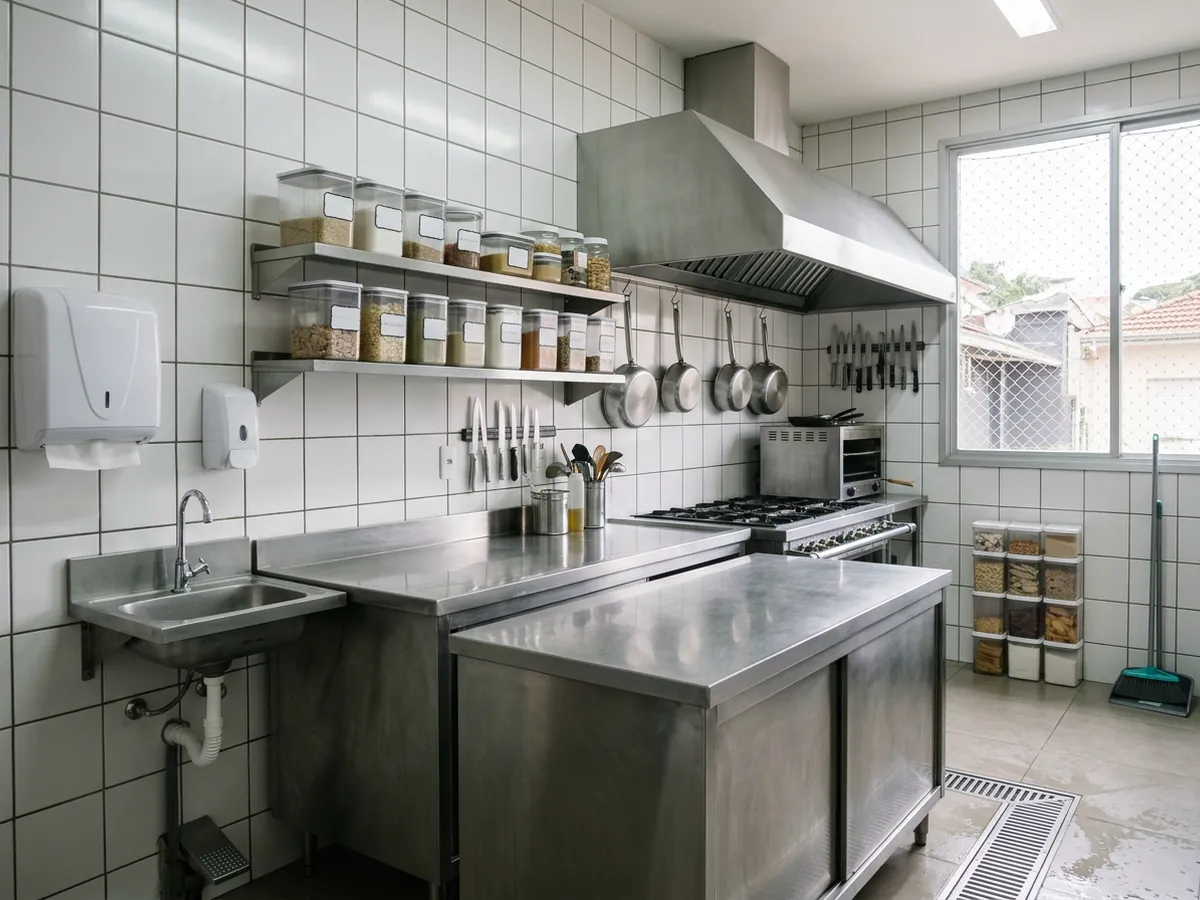
Floors, walls, sinks, exhaust and workflows within the standards.
Technical part
Physical-functional design and DCFF with an ARTTechnical Responsibility Record (Anotação de Responsabilidade Técnica). A CREA record that identifies the engineer responsible for a project, technical report, or construction work. or RRTRRT (Technical Responsibility Record). The equivalent of the ART for architects, registered with the CAU., when required.
Follow-up
Case put together, requirements answered and license issued.
Understand it in one image
Three paths, depending on the activity's risk
- Not on the list
No health license
The activity remains subject to inspection and to good practice rules.
- Medium risk
Integrated license
Issued with the company's registration, with no prior inspection. Restaurant, bakery, salon.
- High risk
Review by Health Surveillance
Declaration of conformity or inspection before the license; at many clinics, also the DCFF with an ART or RRT.
The declared activity decides the path. If an inspection finds a different activity, the license is canceled.
What sets the path for your license
Getting one of these points wrong brings down the license at inspection.- 01 · ActivityThe CNAE actually carried out on site
- 02 · RiskMedium or high, according to the official list
- 03 · SpaceFacilities suited to the activity
- 04 · Technical managerWhen the activity requires one
The license path for each activity
The official list has about 190 activities. The risk level of each one decides the application, the documents and whether there is a prior inspection.
| Risk level | What happens | Examples |
|---|---|---|
| Not on the list | What happens:No health license, but subject to inspection and good practice rules | Examples:Bar, canteen and gym without a pool |
| Medium | What happens:Integrated license (CLI) with the company's registration, with no prior inspection | Examples:Restaurant, snack bar, bakery, beauty salon and medical practice for consultations only |
| High | What happens:Application to Health Surveillance, with a declaration of conformity (DCA) or inspection before the license | Examples:Industrial kitchen, dental practice, drugstore, daycare, nursing home and tattoo studio |
| High, with a physical design | What happens:Also the DCFF, signed by an engineer or architect with an ART or RRT | Examples:Clinic with tests or surgery, laboratory and compounding pharmacy |
The same activity code can change level depending on what is done on site, and an activity different from the one declared gets the license canceled during an inspection. MTC checks activity by activity before the application.
Source: Ordinance SMS No. 266/2025, Annex I (activities and risk level)(opens in a new tab)Why regularize with Health Surveillance
From doors closed by inspectors to a business cleared to operate
Each card shows a common problem. Tap a problem to see how it is solved.
What happens to those operating without a health license
Any health-related activity can be inspected, with or without a license, and Health Surveillance can act on the spot when there is a health risk. At the agency, the path is usually as follows.
- 1
Inspection and requirements
A report with what to correct and the deadline to correct it.
What can be doneBring the space and documents into compliance within the deadline.
- 2
Violation notice
Issued on the spot, with 10 days to file a defense.
What can be doneDefense within the deadline and a compliance plan.
- 3
Fine
From R$ 100 to R$ 500,000, adjusted 2004 values, depending on severity.
What can be doneAppeal within 10 days and regularization of the activity.
- 4
Closure
Partial or total closure and cancellation of the license.
What can be doneMeet the requirements and request release.
Beyond Health Surveillance: what the lack of a license costs
In operations
- Closed doorsClosure in the middle of business hours.
- Seized productsFood and equipment rendered unusable.
In business
- Contracts on holdOutsourced suppliers need a valid license.
- AnvisaPharmacies need the license before the authorization.
In finances
- FinesAmounts adjusted every year.
- Renovation redoneSpace adapted after it is already built.
Opening, moving or received a requirement from Health Surveillance? Contact MTC.
Chat on WhatsAppWhat an up-to-date license brings
Safe operation
Licensed activity, with no risk of closure.
Approved space
Facilities that meet health standards.
More contracts
A license required of anyone who supplies businesses.
Customer trust
License posted in a visible place.
Planned changes
A new address or an expansion without stopping the business.
Renewal on time
Expiry dates tracked.
When it is needed
- Opening a restaurant, clinic, salon or pharmacy
- Change of address or expansion
- New activity or change of CNPJ
- Requirement, violation notice or closure
- License about to expire
- Contract that requires a licensed supplier
Documents that help you get started
You do not need all of them. The team will tell you what is missing.
- Articles of incorporation and CNPJ, with the activities (CNAE)
- Address and photos of the premises
- Floor plan or sketch of the space, if any
- Technical manager's details, if the activity requires one
- Previous license, if any
- Health Surveillance report or notice, if any
How we handle your case
- 1
Classification
CNAE, risk level and required documents.
- 2
Space assessment
Facilities and workflows checked on site.
- 3
Technical part
Physical-functional design and DCFF, when required.
- 4
Application
Complete case and follow-up of requirements.
License issued
Activity cleared, with the license on site.
- The declaration of conformity (DCA) is signed by the company's legal representative, who is responsible for what is declared.
- When the activity requires a health technical manager, such as a pharmacist or a dentist, the company hires that professional.
- Changing address or expanding the activity requires new licensing.
- The license must be kept where the public can see it.
Questions about the health license and Health Surveillance registration
The questions that come to the team and show up in searches most often, with the answer and the source.
See all questionsIt depends on the activity (CNAE). The activities on the official list of Ordinance SMS 266/2025 need one; the list also states the risk level, whether there is an inspection and which documents to submit. All others remain subject to inspection by Health Surveillance (Vigilância em Saúde).
Source: São Paulo City Hall (Health): health licensing (opens in a new tab)It is the number in the Municipal Health Surveillance Registry (Cadastro Municipal de Vigilância em Saúde), which identifies the establishment's Health Operating License. Under the old rule there was a registration and a license; since August 2025, the CMVS is the license number.
Source: Ordinance SMS No. 266/2025 (health licensing) (opens in a new tab)Yes. Restaurants, snack bars and coffee shops are medium-risk activities, with the license integrated into the company's registration. In addition to the license, the kitchen must follow good practice rules, such as the manual and the hygiene procedures, which are checked during inspections.
Source: São Paulo City Hall (Covisa): food FAQ, 2026 (opens in a new tab)Yes, in most cases. A medical practice for consultations only is medium risk. Clinics with tests, clinics with surgery and dental practices are high risk, with a declaration of conformity or an inspection, and clinics with tests or surgery also submit the DCFF.
Source: Ordinance SMS No. 266/2025, Annex I (activities and risk level) (opens in a new tab)The DCFF (Declaração de Conformidade Físico-Funcional, a physical-functional conformity declaration) states that the property meets the health standards for buildings and facilities. It replaced the LTA on June 21, 2024 and is signed by the legal representative and by the project's engineer or architect, with an ART or RRT and a descriptive report.
Source: Ordinance SMS/COVISA No. 404/2024 (DCFF, which replaced the LTA) (opens in a new tab)It depends on the activity: the official list states the validity of each one. Drugstores and compounding pharmacies, for example, have 3 years. Renewal can be requested from 90 days before expiry, and missing the deadline is subject to penalties.
Source: Ordinance SMS No. 266/2025 (health licensing) (opens in a new tab)The Health Code sets a fine of R$ 100 to R$ 500,000, in 2004 values adjusted every year by the IPCA (national inflation index), depending on severity. There may also be closure, seizure of products and cancellation of the license.
Source: Municipal Health Code (Código Sanitário do Município), Law No. 13.725/2004 (opens in a new tab)At medium risk, the license is integrated into the company's registration. At high risk, Health Surveillance has 30 to 120 days to decide, depending on the activity, and the deadline only starts to run once the documentation is complete. Some activities, such as nursing homes and compounding pharmacies, are decided only after the inspection.
Source: Ordinance SMS No. 266/2025 (health licensing) (opens in a new tab)Legal basis and sources
- Municipal Health Code (Código Sanitário do Município), Law No. 13.725/2004(opens in a new tab)
- Decree No. 50.079/2008 (Health Surveillance and CMVS)(opens in a new tab)
- Ordinance SMS No. 266/2025 (health licensing)(opens in a new tab)
- Ordinance SMS No. 266/2025, Annex I (activities and risk level)(opens in a new tab)
- Ordinance SMS/COVISA No. 404/2024 (DCFF, which replaced the LTA)(opens in a new tab)
- Ordinance SMS.G No. 2.619/2011 (good food handling practices)(opens in a new tab)
Informational content, reviewed on November 11, 2026. The rules may change; the analysis of each case considers the rule in force on the date of the application. MTC is a private company, not affiliated with government agencies.

Related services
- Operating LicenseObtaining or regularizing the license for the business to operate at the property, with a review of the site and the activity before the application.See service
- Fire Department: AVCB and CLCBAnalysis, technical design, ART, guidance on required upgrades, and follow-up of the case at the São Paulo State Fire Department.See service
- Accessibility and Accessibility CertificateAdapting existing buildings to the accessibility rules, with design, follow-up of the construction work and filing of the certificate application with City Hall.See service