
Regularization · São Paulo City Hall
Accessibility and Accessibility Certificate
Adapting existing buildings to the accessibility rules, with design, follow-up of the construction work and filing of the certificate application with City Hall.
Quick answer
Accessibility and the Accessibility Certificate in São Paulo, in a few lines
The Accessibility Certificate is issued by São Paulo City Hall when an existing building completes its adaptation to the accessibility rules. It is required for buildings of public and collective use, that is, for any non-residential activity; houses and residential buildings are excluded, but the common areas of apartment buildings must be accessible. The application is made on Aprova Digital, and a building without the certificate may be fined per square meter of the area to be adapted.
Updated on by the MTC technical team, based on the rules cited on this page.
- Who needs it
- Existing building of public or collective use (non-residential) Source: Building Code (Código de Obras e Edificações), Law No. 16.642/2017(opens in a new tab)
- Construction deadline
- Up to 180 days, extendable once Source: Building Code (Código de Obras e Edificações), Law No. 16.642/2017(opens in a new tab)
- Fine
- R$ 200 per m² of the area to be adapted (2017 value), every 90 days Source: Building Code, Annex III (fines)(opens in a new tab)
- Fee in 2026
- From R$ 3.11 to R$ 6.19 per m² of the application area Source: São Paulo City Hall (SMUL): fee table, February 2026(opens in a new tab)
What the Accessibility Certificate is
The Accessibility Certificate is the document São Paulo City Hall issues when an existing building completes its adaptation to accessibility conditions for people with disabilities or reduced mobility. It is required for buildings of public and collective use, that is, for any non-residential activity.
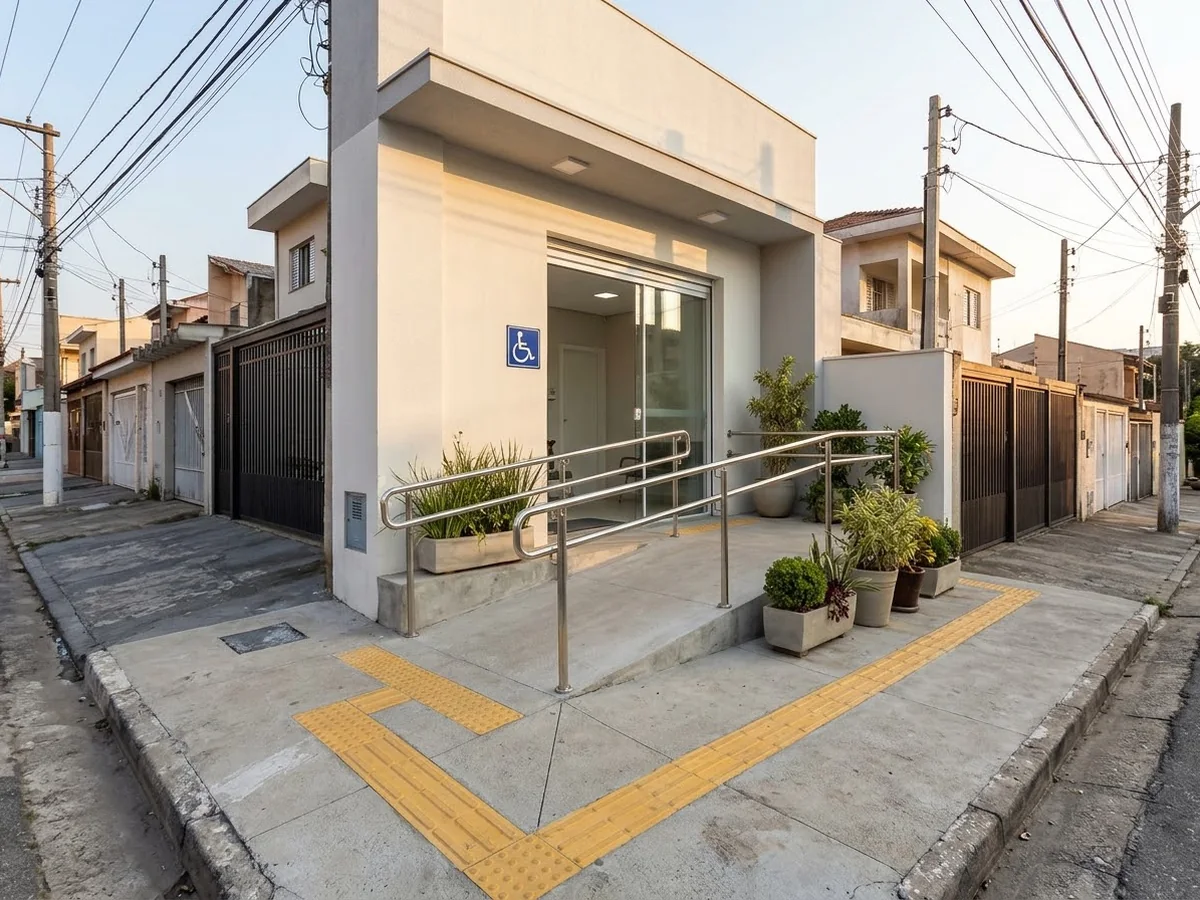
In practice, its absence comes up in the operating license application, in the Safety Certificate, in the assembly venue permit or during enforcement. The adaptation involves an accessible route, an entrance with a ramp or mechanical lift, an accessible restroom and parking spaces, according to NBR 9050.
MTC inspects the property, defines what needs to change, prepares the design and report, and follows the application, the construction work and the issuing of the certificate. When full adaptation is unfeasible, it prepares the technical justification for reasonable accommodation.
What MTC does
Accessibility inspection
Measurement of entrances, circulation paths, doors and restrooms.
Adaptation design
Plans, report and schedule signed by a qualified professional.
Reasonable accommodation
Technical justification when the full work is unfeasible.
Application and follow-up
Filing on Aprova Digital through to issuance of the certificate.
Understand it in one image
From the sidewalk to the restroom, without barriers
- 1Entrance: a ramp at least 1.20 m wide to overcome the level difference from the sidewalk, or mechanical equipment.
- 2Accessible route: a continuous, unobstructed, marked path connecting the rooms.
- 3Accessible restroom, with an independent entrance, in the proportion required by NBR 9050.
- 4No room for the full work? The professional justifies reasonable accommodation, with an ART or RRT.
What City Hall checks in the adaptation
The technical reference is the NBR 9050 in force.- 01 · Accessible routeBarrier-free path between all areas
- 02 · EntranceRamp or mechanical lift to overcome the change in level
- 03 · RestroomAccessible restroom, in the proportion required by NBR 9050
- 04 · ParkingReserved spaces, where there is parking
Does your property need the Accessibility Certificate?
The Building Code and Decree 57.776/2017 separate the cases by the use and the history of the property. Check yours:
1Shop, service business, school, clinic, temple or another existing non-residential use
You must apply for the Accessibility Certificate on Aprova Digital.
2Has a Certificate of Completion issued under Law 11.228/1992 or later
Exempt from the certificate.
3Residential building with several units
No certificate, but all common areas must be accessible.
4House or residential unit
Exempt.
5Older property where full adaptation is unfeasible
Reasonable accommodation, with a justification report and a statement from the professional with an ART or RRT.
6About to apply for a Safety Certificate or assembly venue permit
Apply for the Accessibility Certificate beforehand or together, in its own case.
Why adapt the property
From a property with barriers to an accessible property
Each card shows a common problem. Tap a problem to see how it is solved.
What happens without the certificate
Many companies discover the requirement when applying for a license or during enforcement. Even after being summoned, the company can still apply for the certificate, and the application suspends the enforcement action.
- 1
Pending issue discovered
A license application, a Safety Certificate application or an inspection reveals the gap.
What can be doneInspect the property and put together the adaptation design.
- 2
Summons
Enforcement gives 5 days to apply for the certificate.
What can be doneFile the application, which suspends the enforcement action.
- 3
Fine
Calculated per square meter of the area to be adapted and reapplied every 90 days, for up to 1 year.
What can be doneSubmit a defense within 15 days and proceed with the application.
- 4
Denial
An unanswered “Comunique-se” notice or work done past the deadline leads to denial.
What can be doneAppeal within 30 days or apply again with complete documentation.
Beyond City Hall: where the lack of accessibility shows up
In business
- License deniedThe operating license depends on accessibility.
- Lost customersPeople who cannot get in go somewhere else.
For people
- Employees and visitorsBarriers make everyday life harder for the people who use the place.
- Legal riskRefusing reasonable accommodation is discrimination.
On the property
- Harder to leaseFewer types of business can occupy the property.
- Renovation redoneAdaptation done without a design may not be accepted.
Applying for the license or received a summons? See what the property needs to adapt.
Chat on WhatsAppWhat accessibility brings to the property
License possible
The accessibility requirement is met.
Access for everyone
Customers and employees move around without barriers.
No fine
The property complies with the Building Code.
Legal backing
The design and the certificate prove the adaptation.
Basis for other applications
The Safety Certificate and the assembly venue permit move forward.
Appreciated property
Suits more types of business.
When it is needed
- Operating license application or renewal
- Safety Certificate or assembly venue permit application
- Enforcement summons
- Property renovation
- Requirement from a client, franchise or mall
Documents that help you get started
You do not need all of them. The team will tell you what is missing.
- Property IPTU
- Document of the owner and of the person responsible for the use
- Floor plan of the property, if any
- Habite-se (certificate of occupancy), if any
- Summons received, if any
How we handle your case
- 1
Inspection
Measurement of the property and the barriers.
- 2
Design and report
What to adapt, with schedule and ART.
- 3
Filing
Application on Aprova Digital.
- 4
Construction work
Adaptation within 180 days, extendable once.
Certificate
Follow-up until issuance.
- A residential building does not need the certificate, but the common areas must be accessible.
- A Habite-sePopular name for the Certificate of Completion: a City Hall document confirming that the construction work was finished according to the approved plans. (certificate of occupancy) issued under Law 11.228/1992 or later exempts the building from the certificate.
- When full adaptation is unfeasible, the law accepts justified reasonable accommodation.
Questions about Accessibility and the Accessibility Certificate
The questions that come to the team and show up in searches most often, with the answer and the source.
See all questionsIt is the document City Hall issues when an existing building finishes adapting to accessibility conditions for people with disabilities or reduced mobility.
Source: Building Code (Código de Obras e Edificações), Law No. 16.642/2017 (opens in a new tab)Existing buildings of public or collective use, which means any non-residential activity. Anyone who has a Certificate of Completion issued under Law 11.228/1992 or later is exempt.
Source: Decree No. 57.776/2017, which regulates the Building Code (opens in a new tab)It does not need the certificate, but all common areas of the building must be accessible.
Source: Building Code (Código de Obras e Edificações), Law No. 16.642/2017 (opens in a new tab)The law sets no term. The certificate loses its validity if the property undergoes a physical change from what City Hall accepted.
Source: Building Code (Código de Obras e Edificações), Law No. 16.642/2017 (opens in a new tab)Yes. Under federal law, granting and renewing the operating permit (alvará de funcionamento) depend on compliance with the accessibility rules. In the city of São Paulo, the license application includes the filing of the Accessibility Certificate when it applies.
Source: Statute of Persons with Disabilities, Law No. 13.146/2015 (opens in a new tab)A building without the certificate receives a 5-day summons to apply for it. After that, the fine is R$ 200 per m² of the area to be adapted (2017 value, adjusted every year), reapplied every 90 days for up to 1 year. Applying for the certificate suspends the enforcement.
Source: Building Code (Código de Obras e Edificações), Law No. 16.642/2017 (opens in a new tab)When adaptation is technically unfeasible, reasonable accommodation is accepted. The professional declares the unfeasibility, with an ART or RRT, and submits a justification report (memorial).
Source: Decree No. 57.776/2017, which regulates the Building Code (opens in a new tab)In 2026, the City Hall fee ranges from R$ 3.11 to R$ 6.19 per m² of the application area, depending on the size of the building. The professional's fee is separate.
Source: São Paulo City Hall (SMUL): fee table, February 2026 (opens in a new tab)Legal basis and sources
- Building Code (Código de Obras e Edificações), Law No. 16.642/2017(opens in a new tab)
- Decree No. 57.776/2017, which regulates the Building Code(opens in a new tab)
- São Paulo City Hall (SMUL): Accessibility Certificate(opens in a new tab)
- Statute of Persons with Disabilities, Law No. 13.146/2015(opens in a new tab)
- Federal Decree No. 5.296/2004 (accessibility)(opens in a new tab)
- São Paulo City Hall (SMUL): fee table, February 2026(opens in a new tab)
Informational content, reviewed on October 22, 2026. The rules may change; the analysis of each case considers the rule in force on the date of the application. MTC is a private company, not affiliated with government agencies.
Related services
- Safety CertificateAnalysis and adaptation of existing buildings to the conditions of safe use required by municipal law.See service
- Operating LicenseObtaining or regularizing the license for the business to operate at the property, with a review of the site and the activity before the application.See service
- Safety Verification Certificate (AVS)Technical guidance, drawings, ART and follow-up of the AVS (Safety Verification Certificate) at City Hall, for venues open to the public.See service