
Safety and Fire Department · São Paulo City Hall
Safety Certificate
Analysis and adaptation of existing buildings to the conditions of safe use required by municipal law.
Quick answer
Safety Certificate in São Paulo at a glance
The Safety Certificate is the São Paulo City Hall document that proves an existing building has been adapted to occupancy safety conditions, such as protected stairs, ramps and corridors. It applies to non-residential buildings with no AVS or earlier certificate; residential buildings are excluded. Above 750 m², the AVCB may replace it.
Updated on by the MTC technical team, based on the rules cited on this page.
- Basis
- Building Code, art. 43 Source: Building Code (Código de Obras e Edificações), Law No. 16.642/2017(opens in a new tab)
- Not required
- Residential buildings and anyone who already has an AVS Source: Decree No. 57.776/2017, which regulates the Building Code(opens in a new tab)
- Above 750 m²
- Non-residential: the AVCB may replace the certificate Source: Decree No. 57.776/2017, which regulates the Building Code(opens in a new tab)
- Agency
- SMUL/CONTRU, applied for through Aprova Digital Source: São Paulo City Hall (SMUL): Safety Certificate(opens in a new tab)
What the Safety Certificate is
The Safety Certificate is the City Hall document for existing buildings that must prove they are adapted to occupancy safety conditions, such as exits, stairs and protected circulation. The application also includes the Accessibility Certificate.
It is usually required of older buildings, built before the current rules, and of properties that changed use. A residential building that starts housing offices, for example, must adapt to the new use.
MTC inspects the building, defines what needs to be adapted, prepares the technical documents and follows the application through to the issuance of the certificate.
What MTC does
Building inspection
Survey of the current occupancy safety conditions.
Adaptation plan
List of what needs to be adjusted, in order of priority.
Technical documents and ART
Floor plans and reports signed by a licensed professional.
Follow-up
Filing at City Hall until the certificate is issued.
Understand it in one image
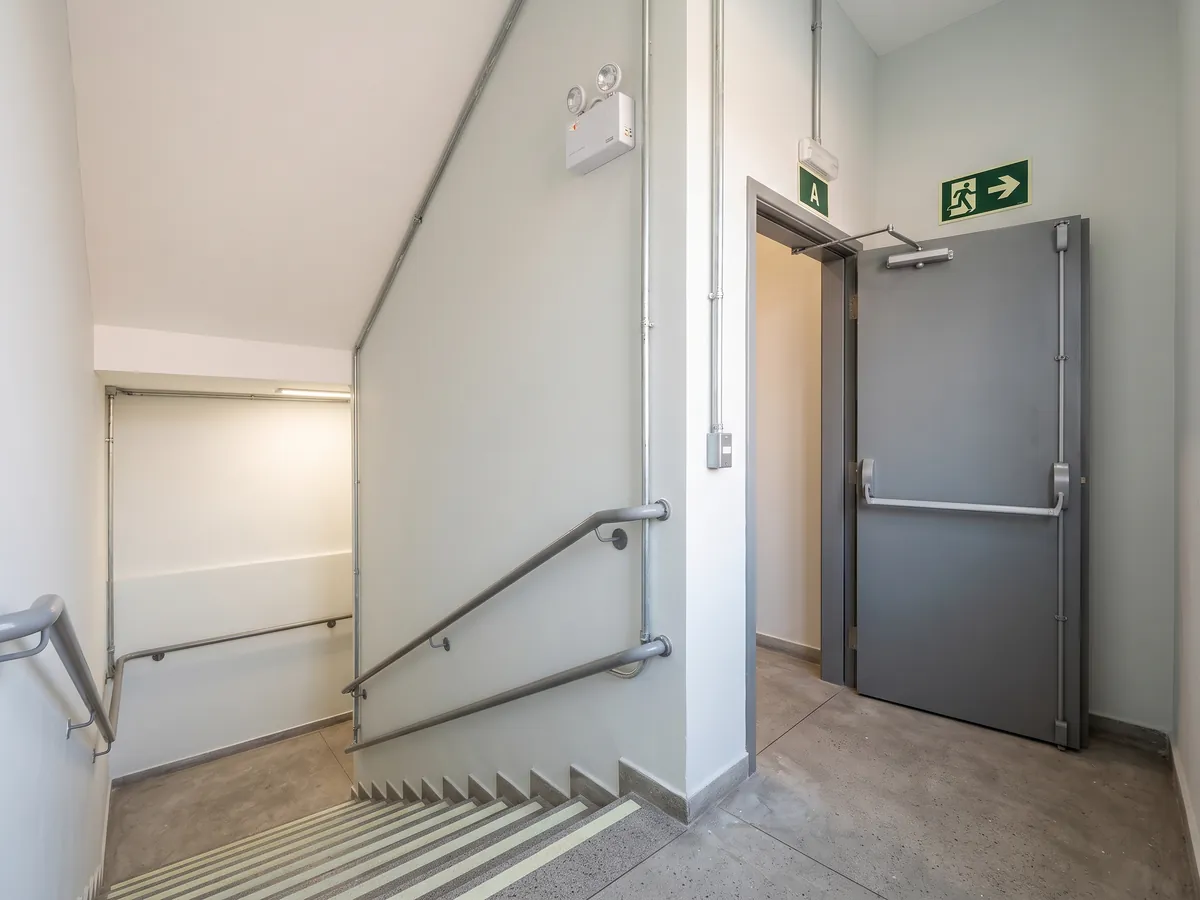
What protected circulation is
- 1Whoever is on the floor follows the corridor to the stairs.
- 2A fire door separates the stairs from the floor, so smoke cannot get in.
- 3The protected stairs take everyone to the exit on the ground floor.
- 4Above 750 m², in non-residential use, the AVCB may replace the certificate.
What is checked in the existing building
The adaptation considers the age, use and structure of the building.- 01 · StairsWidth, handrails and protection
- 02 · ExitsRoutes to the public street
- 03 · CirculationCorridors and common areas
- 04 · AccessibilityAccess for people with disabilities
Is your building exempt from the Safety Certificate?
Decree 57.776/2017 lists who does not need to apply. Check in order: if your case falls under one of the first items, the certificate is not required.
1The building is residential
Exempt from the certificate.
2Was approved after June 20, 1975, has a Certificate of Completion and has not changed
Exempt, if there was no physical change or change of use.
3Already has an AVS
Exempt: the AVS is valid in place of the certificate.
4It is non-residential with more than 750 m²
The certificate may be replaced by the Fire Department's AVCB.
5None of the cases above
You need to apply for the Safety Certificate, with a Technical Safety Report and installation attestations.
The City Hall page uses a different cutoff date (completion after February 7, 1974). The analysis confirms the rule that applies to your property.
Source: Decree No. 57.776/2017, which regulates the Building Code(opens in a new tab)Why have the Safety Certificate
From an outdated building to an adapted building
Each card shows a common problem. Tap a problem to see how it is solved.
What happens without the certificate
Older buildings often operate for years without the certificate, until an inspection, a license application or a sale reveals the issue. Once the issue is found, the application can still be filed.
- 1
Pending issue discovered
An inspection, a license or a sale reveals that the building needs the certificate.
What can be doneCarry out the technical inspection and put together the adaptation plan.
- 2
Notification
City Hall requires the adaptation within a deadline.
What can be doneRespond within the deadline with the schedule of adaptations.
- 3
Violation notice
Without a response, the building is fined.
What can be doneFile the application and show the progress of the work.
- 4
Closure
Floors or the whole building have restricted use.
What can be doneComplete the adaptations and request clearance with the certificate.
Where the lack of a Safety Certificate shows up
For the occupants
- Licenses deniedCompanies in the building cannot operate regularly.
- Contracts terminatedTenants leave properties with pending issues.
In safety
- Risk to peopleInadequate exits increase the risk in emergencies.
- Building manager's liabilityThe condominium answers for the common areas.
In property value
- Loss of valueA property with a pending issue attracts fewer interested parties.
- Slower saleBuyers demand that the situation be resolved.
Older building or changed use? Check whether you need the certificate.
Chat on WhatsAppWhat the certificate brings to the building
Updated building
The building meets the occupancy safety rules.
Occupancy cleared
Companies and residents use the property without restriction.
Value preserved
A regular property keeps its sale and rental value.
Lower risk
Adequate exits and circulation protect the people in the building.
Basis for other documents
Makes the AVCB, AVS and operating license easier.
Condominium management
A building manager (síndico) with technical documentation for decisions about building work.
When it is needed
- Older buildings in use
- Change of use of the property
- Notification from City Hall
- Operating license application
- Renovation or adaptation of the building
Documents that help you get started
You do not need all of them. The team will tell you what is missing.
- Property record (matrícula)
- Approved or existing floor plan
- Habite-se (certificate of occupancy), if any
- Notification received, if any
- AVCB and installation attestations, if any
How we handle your case
- 1
Initial analysis
Building situation and applicable requirements.
- 2
Inspection
Technical survey on site.
- 3
Adaptation plan
What to adjust and in what order.
- 4
Documents and ART
Floor plans, descriptive reports and technical responsibility.
Filing
Application and follow-up until issuance.
- The adaptations needed depend on the building's age, use and structure.
- Some work may require its own permit.
- The timeline depends on City Hall and on the adaptations.
Questions about the Safety Certificate
The questions that come to the team and show up in searches most often, with the answer and the source.
See all questionsIt is the document that proves an existing building has been adapted to occupancy safety conditions, focusing on protected circulation and fire safety for the building's use.
Source: Building Code (Código de Obras e Edificações), Law No. 16.642/2017 (opens in a new tab)It does if it is an existing building that needs protected stairs, ramps or corridors and has no AVS or valid earlier certificate.
Source: Decree No. 57.776/2017, which regulates the Building Code (opens in a new tab)No. Decree 57.776/2017 leaves residential buildings outside this requirement.
Source: Decree No. 57.776/2017, which regulates the Building Code (opens in a new tab)No, if it was approved after June 20, 1975, has a Completion Record (Auto de Conclusão) or Certificate of Completion, and has had no physical change or change of use.
Source: Decree No. 57.776/2017, which regulates the Building Code (opens in a new tab)No. The certificate comes from City Hall; the AVCB comes from the Fire Department. In a non-residential building above 750 m², the AVCB may replace the certificate.
Source: Decree No. 57.776/2017, which regulates the Building Code (opens in a new tab)Technical Safety Report, floor plans showing the equipment, descriptive report and work schedule, the Accessibility Certificate or its filing receipt, and attestations with ART or RRT for the installations, such as electrical, lightning protection, gas, generator and elevators.
Source: São Paulo City Hall (SMUL): Safety Certificate (opens in a new tab)The owner or possessor, through Aprova Digital. The case is opened after the TEV/COE fee is paid.
Source: São Paulo City Hall (SMUL): Safety Certificate (opens in a new tab)City Hall may order the person responsible to apply for the document within 5 days, under penalty of a fine.
Source: Building Code (Código de Obras e Edificações), Law No. 16.642/2017 (opens in a new tab)Legal basis and sources
- Building Code (Código de Obras e Edificações), Law No. 16.642/2017(opens in a new tab)
- Decree No. 57.776/2017, which regulates the Building Code(opens in a new tab)
- São Paulo City Hall (SMUL): Safety Certificate(opens in a new tab)
Informational content, reviewed on October 22, 2026. The rules may change; the analysis of each case considers the rule in force on the date of the application. MTC is a private company, not affiliated with government agencies.
Related services
- Fire Department: AVCB and CLCBAnalysis, technical design, ART, guidance on required upgrades, and follow-up of the case at the São Paulo State Fire Department.See service
- Safety Verification Certificate (AVS)Technical guidance, drawings, ART and follow-up of the AVS (Safety Verification Certificate) at City Hall, for venues open to the public.See service
- Technical reports and attestationsTechnical reports, written reports, inspections and attestations for properties, businesses and administrative cases, prepared by a qualified professional.See service