
Reports and ART · Qualified professional
Precautionary report on neighboring properties
Inspection of the neighboring properties before construction, with photos and a record of the cracks and defects that already exist, so the builder and the people next door know what has changed, without arguing over what was already there.
Quick answer
Precautionary report on neighboring properties in São Paulo, in a few lines
The precautionary report on neighboring properties is the technical record of the condition of the neighboring properties before construction: type, construction standard, state of repair and the existing cracks and defects, with photos of each room. Under ABNT NBR 13752:2024 and the 2025 IBAPE/SP standard, it is a fact-finding inspection, carried out before demolition and excavation, that records what exists without determining causes. Because the Civil Code gives neighbors the right to compensation for damage caused by construction, the report is proof of what already existed before it. MTC helps define the properties, carries out the inspections and delivers the report with photos, signed with an ART or RRT.
Updated on by the MTC technical team, based on the rules cited on this page.
- Technical standard
- ABNT NBR 13752:2024 and the IBAPE/SP standard Source: ABNT NBR 13752:2024 (engineering forensic investigations in civil construction)(opens in a new tab)
- When to do it
- Before demolition and excavation Source: IBAPE/SP: Neighborhood Precautionary Inspection Standard (2025)(opens in a new tab)
- Who signs
- Engineer or architect, with ART or RRT Source: IBAPE/SP: Neighborhood Precautionary Inspection Standard (2025)(opens in a new tab)
- Damage to the neighbor
- Compensation even with protective works Source: Civil Code, arts. 1.277, 1.299, 1.311 and 1.312 (neighbor rights and the right to build)(opens in a new tab)
What a precautionary report on neighboring properties is
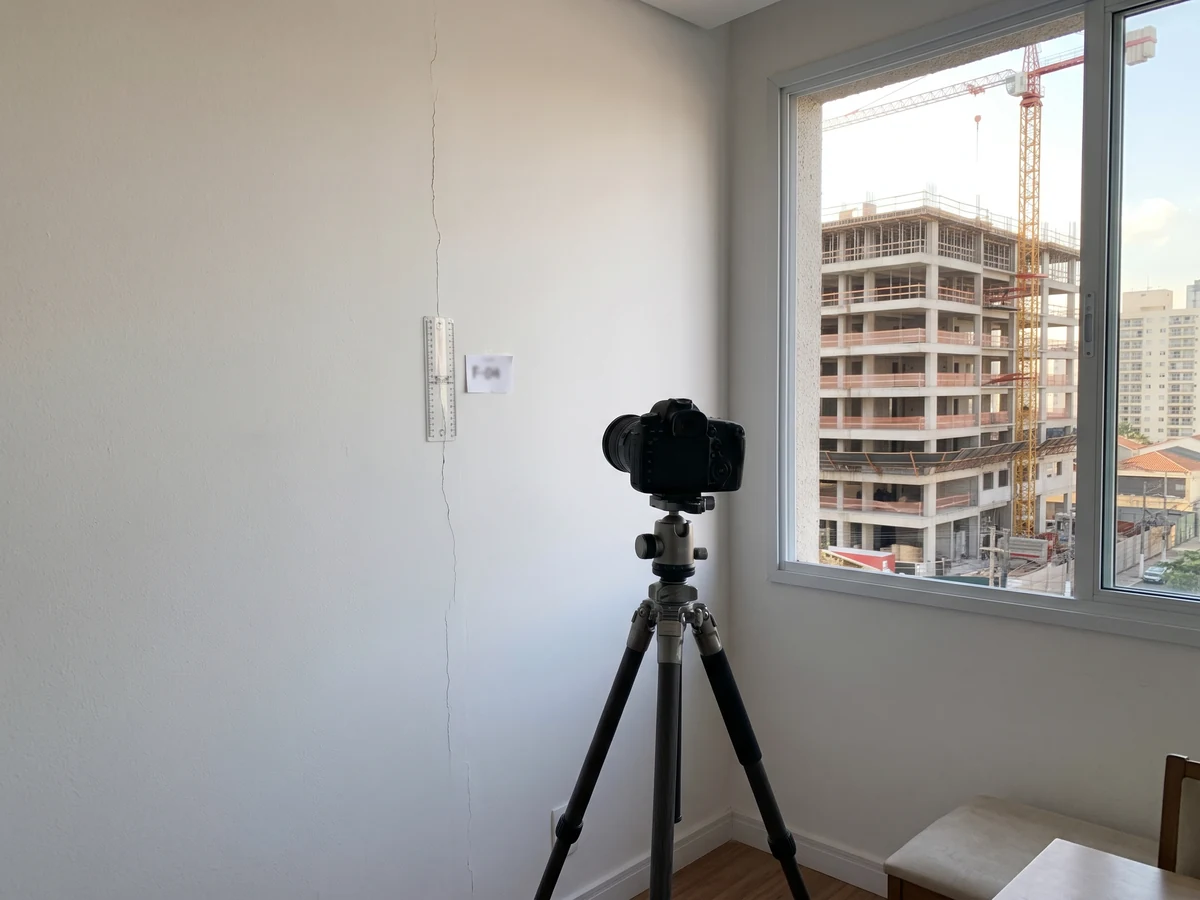
The precautionary report on neighboring properties is a technical snapshot of the properties next to a construction project, made before it starts. The engineer or architect inspects each property, outside and, with permission, inside, and records the type, construction standard, state of repair and the existing hairline cracks, cracks, leaks and defects, with photos of each room. Under ABNT NBR 13752:2024, it is a fact-finding inspection: it describes what exists, without determining causes.
Demolition, excavation, foundations and lowering of the water table can affect those next door. The Civil Code prohibits construction that compromises the safety of the neighboring building without protective works and, in art. 1.311, gives the neighbor the right to compensation for damage even when such works were carried out. Without a record of the before, every crack becomes an argument: the neighbor says it came from the construction, and the builder says it was already there.
What most often gets in the way is access: without the occupant's permission, only what can be seen from outside can be recorded, and the refusal must be documented. MTC's engineers and architects help define which properties to inspect, carry out the inspections, record the access attempts and deliver the report with photos and a sketch, signed with an ARTTechnical Responsibility Record (Anotação de Responsabilidade Técnica). A CREA record that identifies the engineer responsible for a project, technical report, or construction work. or RRTRRT (Technical Responsibility Record). The equivalent of the ART for architects, registered with the CAU., ready for the conversation between the parties or for the lawyer.
What MTC does
Choosing the properties
Which neighbors to inspect, based on the soil, the foundation and the excavation.
On-site inspection
Facades, rooms, walls and roof, with photos of each.
Recording the defects
Hairline cracks, cracks, leaks and defects, with the location of each.
Signed report
Sketch, photos and the date of each inspection, with an ARTTechnical Responsibility Record (Anotação de Responsabilidade Técnica). A CREA record that identifies the engineer responsible for a project, technical report, or construction work. or RRTRRT (Technical Responsibility Record). The equivalent of the ART for architects, registered with the CAU..
Understand it in one image
From the contract to the report used in negotiations or in court
- 1
Contract
The construction, soil and foundation define the properties and the level.
- 2
Contact
Permission from each occupant; a refusal is recorded.
- 3
Inspection
Facades, rooms and defects, with photos and location.
- 4
Report before construction
Condition of each property, signed with an ART or RRT.
- 5
Report in use
The before compared with the after, in an agreement or in court.
Has construction already started? An inspection is still worthwhile: the report records the condition of the property on the inspection date.
What the precautionary report records
It is the snapshot of the before, for comparison afterward.- 01 · PropertyType, use, standard and estimated age
- 02 · State of repairCondition of each room, with photos
- 03 · AnomaliesHairline cracks, cracks and defects, with location
- 04 · ConstructionPosition of the property relative to the construction site
Construction next door: which case is yours
The report protects both the builder and the people next door. The right time and the path change depending on your side of the construction and the phase it is in.
1I am going to demolish, excavate or build foundations near houses or buildings
Precautionary report on the neighboring properties before demolition and again before excavation, with the inspection level defined by the construction and the soil.
2I am a neighbor and a large construction project is about to start next door
Ask the builder whether your property is included in the inspection. If it is not, it is worth having your own report before the machines arrive.
3Construction has already started and no one did an inspection
Inspect as soon as possible: the report records the condition of the property on that date, and each day without a record adds to the doubt about what already existed.
4Cracks appeared during construction
A new inspection, compared with the precautionary report. Determining the cause and who is responsible is a forensic investigation, a different stage.
5The neighbor will not allow entry
The attempt is formalized with a notice, sent by mail or through a registry office, and the report records what can be seen from outside. The court route is handled by the lawyer.
6Major renovation in a condominium unit
The IBAPE/SP standard also applies to major renovations: the neighboring units and the common areas can be inspected beforehand.
There is no fixed radius. The list of properties comes from analyzing the soil, the foundation, the difference in level and the retaining structures, and the client decides the final scope.
Source: IBAPE/SP: Neighborhood Precautionary Inspection Standard (2025)(opens in a new tab)Why get the precautionary report
From a disputed crack to proof of what already existed
Each card shows a common problem. Tap a problem to see how it is solved.
How doubt grows when there is no report
Without a record of the before, every crack, new or old, becomes grounds for a complaint. The conversation between neighbors gets out of hand and reaches City Hall and the courts.
- 1
Construction with no record
Demolition and excavation start without an inspection of the neighboring properties.
What can be doneInspect before demolition and before excavation.
- 2
Crack next door
A crack appears, and no one can say whether it was already there.
What can be doneA new inspection, compared with the precautionary report.
- 3
Formal notice from City Hall
Stability conditions not met: 5 days to start the fix, closure and daily fines.
What can be doneReport, repair design and technical manager.
- 4
Court action
The neighbor seeks compensation, and whoever breaks the building rules is liable for losses and damages.
What can be doneTechnical reports for the lawyer and for the court-appointed expert.
Beyond the construction site: what the lack of a report costs
For the builder
- Schedule at riskComplaints in the middle of construction.
- Undue repairsPaying for a defect that already existed.
For the neighbor
- Damage without proofHard to show what the construction caused.
- Strained relationsDistrust throughout the construction.
In court
- Long lawsuitForensic investigation after the construction, without the before.
- Losses and damagesCompensation to the neighbor for the damage.
Demolishing, excavating or have construction starting next door? Contact MTC before the machines arrive.
Chat on WhatsAppWhat the precautionary report brings
Proof of the before
Condition of each property, with photos and date.
Fewer disputes
Only what changed after the inspection is discussed.
Both sides protected
The builder and the people next door.
Risks in sight
Signs of weakness pointed out before construction.
Basis for an agreement
Technical comparison to negotiate repairs.
Technical responsibility
Signed report, with an ART or RRT.
When it is needed
- Before demolishing a building on the lot
- Before excavating a basement or building the foundation
- Retaining structures, retaining walls or lowering of the water table
- Large construction starting next to a house or building
- Major renovation in a condominium unit
- Public works near the property, such as the subway or a drainage gallery
Documents that help you get started
You do not need all of them. The team will tell you what is missing.
- Address and design of the construction, with the site plan
- Type of foundation, retaining structures and excavation depth
- Soil investigation or geotechnical study, if any
- List of neighboring properties and the occupants' contact details
- Demolition and excavation schedule
- Previous reports and inspections, if any
How we handle your case
- 1
Scope
The construction, soil and foundation define the properties and the level.
- 2
Contact
Permission and scheduling with each occupant.
- 3
Inspection
Facades, rooms and defects, with photos.
- 4
Registration
Sketch, description and documented refusals.
Report
Report on each property, with an ART or RRT, before construction.
- The report records the condition of the property on the date of the inspection; it does not identify causes or who is at fault.
- Without the occupant's permission, the inspection is limited to what can be seen from outside, and the attempt is recorded.
- It is not the Neighborhood Impact Study (EIV), which City Hall requires for certain developments.
- Notices, agreements and lawsuits are handled by the lawyer; MTC takes care of the technical part.
Questions about the precautionary report on neighboring properties
The questions that come to the team and show up in searches most often, with the answer and the source.
See all questionsIt is the technical record, with photos, of the condition of the neighboring properties before construction: type, construction standard, state of repair, estimated age and the existing hairline cracks, cracks and defects. Under NBR 13752:2024, it is a fact-finding inspection, which preserves a lasting record of the property without determining causes.
Source: ABNT NBR 13752:2024 (engineering forensic investigations in civil construction) (opens in a new tab)The São Paulo Building Code does not require the report for the permit, but it does require all earthworks to preserve the safety of neighboring properties. NBR 12722 says the inspection should be done whenever the construction may affect the neighbors. And the Civil Code gives the neighbor the right to compensation even when protective works were carried out: the report is proof of what already existed.
Source: Building Code, Annex I, item 3.5 (earthworks and adjoining properties) (opens in a new tab)An engineer or architect licensed with CREA or CAU. The report carries the signature, the registration number and the ART or RRT, as well as the access authorization forms for the properties inspected.
Source: IBAPE/SP: Neighborhood Precautionary Inspection Standard (2025) (opens in a new tab)There is no fixed radius. The professional recommends the properties based on the soil, the type of foundation, the difference in level, the retaining structures, the lowering of the water table, the age of the buildings and the traffic, and the standard recommends consulting a geotechnical specialist. The client may shorten the list, at their own responsibility.
Source: IBAPE/SP: Neighborhood Precautionary Inspection Standard (2025) (opens in a new tab)Record the cracks with photos and dates, notify the person responsible for the construction in writing and call an engineer or architect for a report on the current condition. The Civil Code gives the neighbor the right to compensation for damage, even if protective works were carried out. Agreements and lawsuits are handled by the lawyer.
Source: Civil Code, arts. 1.277, 1.299, 1.311 and 1.312 (neighbor rights and the right to build) (opens in a new tab)The inside inspection depends on the occupant's permission. If they refuse or cannot be found, the IBAPE/SP standard recommends sending a notice by mail or through a registry office to formalize the attempt, and the report records what can be seen from outside. In court, there is the early production of evidence, requested by the lawyer.
Source: Code of Civil Procedure, arts. 381 to 383 (early production of evidence) (opens in a new tab)The precautionary inspection is a fact-finding inspection: it describes the condition of the property on a given date, without determining causes, responsibilities or solutions. A causation investigation looks into the origin of damage and who is liable for it, and usually uses the precautionary report as the reference for the before.
Source: ABNT NBR 13752:2024 (engineering forensic investigations in civil construction) (opens in a new tab)It is not required. The IBAPE/SP standard leaves it to the client to decide how to fix the date of the findings and suggests a digital signature or registering the report at a registry office.
Source: IBAPE/SP: Neighborhood Precautionary Inspection Standard (2025) (opens in a new tab)Legal basis and sources
- ABNT NBR 13752:2024 (engineering forensic investigations in civil construction)(opens in a new tab)
- IBAPE/SP: Neighborhood Precautionary Inspection Standard (2025)(opens in a new tab)
- ABNT NBR 12722:1992, item 4.1.10 (preliminary inspection of neighboring properties)(opens in a new tab)
- Civil Code, arts. 1.277, 1.299, 1.311 and 1.312 (neighbor rights and the right to build)(opens in a new tab)
- Code of Civil Procedure, arts. 381 to 383 (early production of evidence)(opens in a new tab)
- Building Code, Annex I, item 3.5 (earthworks and adjoining properties)(opens in a new tab)
- CREA-SP: ART issuance(opens in a new tab)
Informational content, reviewed on November 11, 2026. The rules may change; the analysis of each case considers the rule in force on the date of the application. MTC is a private company, not affiliated with government agencies.
Related services
- Technical reports and attestationsTechnical reports, written reports, inspections and attestations for properties, businesses and administrative cases, prepared by a qualified professional.See service
- Construction, renovation and demolition permitDesign, technical responsibility and follow-up of the Approval Permit and the Construction Permit at City Hall, so the work starts in compliance and ends with the Habite-se.See service
- Building inspection (NBR 16747)Inspection of the building by engineers and architects, with a report on anomalies, maintenance failures and priorities, so the building manager (síndico) can decide on building work safely and on a technical basis.See service