
Reports and ART · Qualified professional
Building inspection (NBR 16747)
Inspection of the building by engineers and architects, with a report on anomalies, maintenance failures and priorities, so the building manager (síndico) can decide on building work safely and on a technical basis.
Quick answer
Building inspection (NBR 16747) in São Paulo, in a few lines
Building inspection is the assessment of the entire building by an engineer or architect, under the technical standard ABNT NBR 16747. The professional analyzes the documents, inspects all the systems and delivers a report with the anomalies, the maintenance failures and priorities 1, 2 and 3, signed with an ART or RRT. In São Paulo, the duty to maintain the common areas lies with the building manager (síndico), and the report is the technical basis for deciding on building work and the budget. MTC carries out the full inspection and delivers the report with the priorities.
Updated on by the MTC technical team, based on the rules cited on this page.
- Who signs
- Engineer or architect, with ART or RRT Source: IBAPE: Building Inspection Standard (2025)(opens in a new tab)
- Priorities
- Three levels: 1, 2 and 3 Source: IBAPE: Building Inspection Standard (2025)(opens in a new tab)
- Building manager's duty
- Maintain the common areas Source: Civil Code, arts. 937, 938, 1.341 and 1.348 (upkeep and duties of the building manager)(opens in a new tab)
What building inspection is
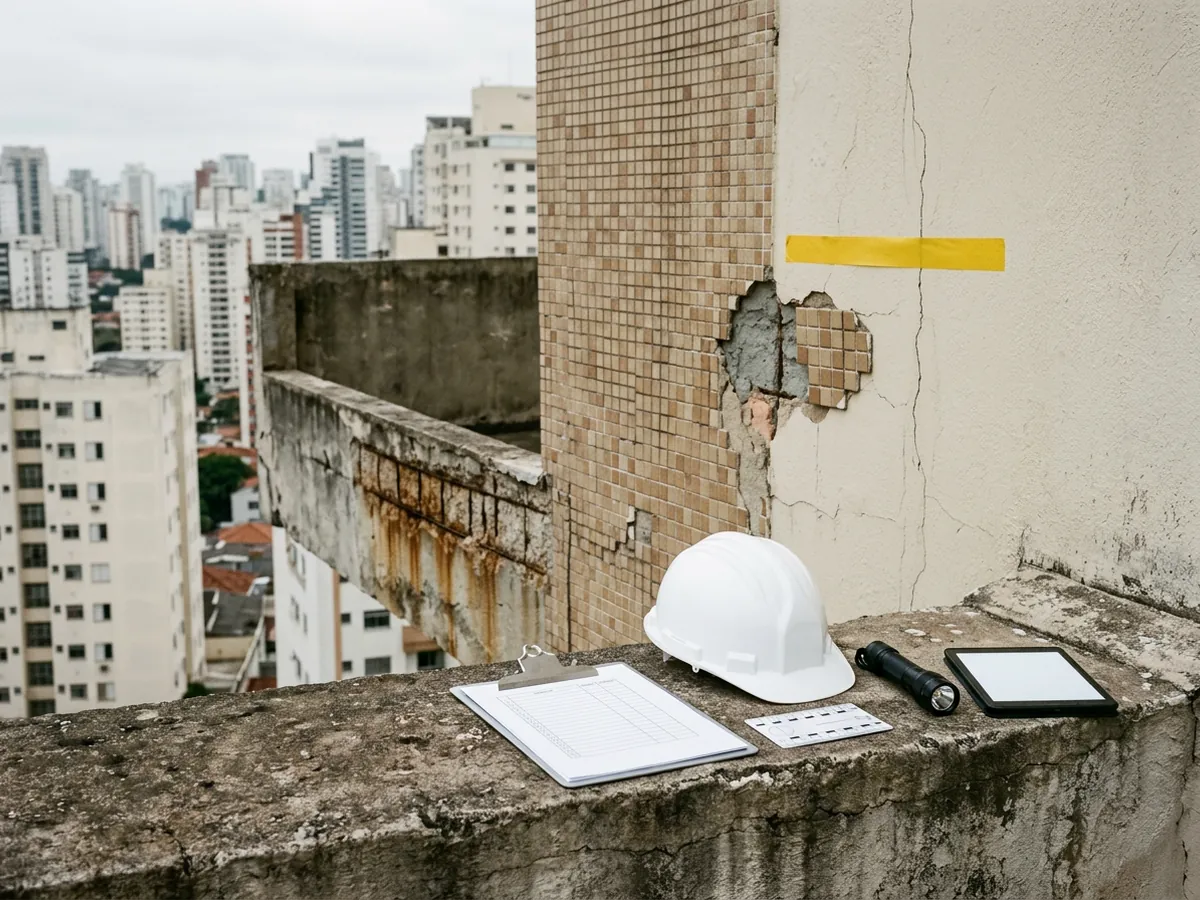
Building inspection is the assessment of the entire building by an engineer or architect, under the technical standard ABNT NBR 16747. The professional analyzes the documents, talks to people who know the building's history and inspects all the systems: structure, facades, roof, electrical and plumbing installations, gas, fire protection, elevators and equipment.
The result is a report with the anomalies and maintenance failures, the origin of each one, what to do and in what order: priority 1, 2 or 3. The report also states whether maintenance follows NBR 5674, and it is signed with an ARTTechnical Responsibility Record (Anotação de Responsabilidade Técnica). A CREA record that identifies the engineer responsible for a project, technical report, or construction work. or RRTRRT (Technical Responsibility Record). The equivalent of the ART for architects, registered with the CAU.. For the building manager (síndico), who has the legal duty to maintain the common areas, it is the basis for planning building work and the budget.
Without this picture, a small fault turns into costly damage: a leak that reaches the reinforcement steel, facade cladding that comes loose, a water tank that is not cleaned. MTC's engineers and architects carry out the full inspection, deliver the report with the priorities and present the results to the building manager and, when needed, to the owners' meeting.
What MTC does
Document review
Designs, AVCBFire Department Inspection Certificate (Auto de Vistoria do Corpo de Bombeiros). Certifies that the property has the required fire safety measures., maintenance plan, contracts and reports.
Full inspection
Structure, facades, roof, installations and equipment.
Report with priorities
Anomalies, failures, recommendations and priority 1, 2 or 3.
Technical responsibility
Report signed by an engineer or architect, with an ARTTechnical Responsibility Record (Anotação de Responsabilidade Técnica). A CREA record that identifies the engineer responsible for a project, technical report, or construction work. or RRTRRT (Technical Responsibility Record). The equivalent of the ART for architects, registered with the CAU..
Understand it in one image
The stages of an inspection under NBR 16747
- 1
Documents
What the building has and what is missing.
- 2
Interview
History of repairs, renovations and changes of use.
- 3
Inspection
All systems, on site, with simple tests.
- 4
Classification
Anomaly or failure, and the origin of each.
- 5
Priorities
1, 2 or 3, in the report signed with ART or RRT.
Priority 1 is what affects the health or safety of the people who use the building: it is first in line at the owners' meeting.
What the inspection report shows
Without any one of these points, the report does not follow the standard.- 01 · DocumentsWhat was provided and what is missing
- 02 · IrregularitiesAnomalies and failures, with photos and origin
- 03 · PrioritiesWhat to do first: 1, 2 or 3
- 04 · MaintenanceWhether the plan follows NBR 5674
How the report organizes the building's priorities
NBR 16747 replaced the old risk grade with three priority levels. That is what turns the inspection into a plan the owners' meeting can vote on.
| Priority | When it applies | How the condominium handles it |
|---|---|---|
| 1 | When it applies:Risk to the health or safety of the people who use the building, shutdown of systems, loss of service life or damage to the environment | How the condominium handles it:First in line. Necessary and urgent repairs can be carried out by the building manager, who informs the owners' meeting when the expense is high |
| 2 | When it applies:Partial loss of performance that affects operation without putting the people who use the building at risk | How the condominium handles it:Short and medium term. A high, non-urgent expense goes to the owners' meeting |
| 3 | When it applies:Minor damage to appearance, or actions that can be scheduled | How the condominium handles it:Maintenance plan and the year's budget forecast |
The report also separates maintenance from repairs or renovations, so the owners' meeting can vote on the budget on a technical basis.
Source: IBAPE: Building Inspection Standard (2025)(opens in a new tab)Why inspect the building
From problems found too late to a building cared for with a plan
Each card shows a common problem. Tap a problem to see how it is solved.
How the problem grows in a building without inspection
The problem almost always starts small and goes unnoticed. Without an inspection, it only shows up when it is already expensive or when City Hall is called in.
- 1
Maintenance failure
Grout, seals, gutters or water tanks left without care.
What can be doneFix it within the maintenance plan.
- 2
Greater damage
Leaks, corrosion of the reinforcement steel, cladding that comes loose.
What can be donePlanned repair, with the priority set in the report.
- 3
Formal notice from City Hall
Unsafe conditions: 5 days to start the fix, closure and daily fines.
What can be doneReport, repair design and technical manager.
- 4
Accident
The building owner is liable for damage caused by a lack of repairs.
What can be doneIsolate the hazard and carry out the priority 1 repair.
Beyond the building: what the lack of inspection costs
At the owners' meeting
- Work without consensusEach resident has a different priority.
- Budgeting in the darkSpending without a technical basis.
On responsibility
- Building manager exposedLegal duty to maintain the common areas.
- Warranty at riskMaintenance that does not follow the manual counts against you.
In finances
- Bigger repairA small fault that turns into major work.
- Reserve fundEmergency spending that could have been planned for.
Just took over managing the condominium or have work to put to a vote? Talk to MTC before the owners' meeting.
Chat on WhatsAppWhat the inspection brings to the building
Clear priorities
What to do first, with the reasons.
Informed owners' meeting
Photos and a report to vote on the work.
Predictable budget
Planned maintenance instead of emergencies.
Higher building value
Upkeep that is up to date and documented.
Warranty monitored
Maintenance assessed against the manual and the standard.
Technical responsibility
Report with ART or RRT.
When it is needed
- Change of building manager or management company
- Owners' meeting to decide on work or the budget
- End of the builder's warranty
- Leaks, cracks, exposed rebar or a facade coming loose
- Purchase of a building, a floor or a full office floor
- Preparing to renew the AVCBFire Department Inspection Certificate (Auto de Vistoria do Corpo de Bombeiros). Certifies that the property has the required fire safety measures. or the Maintenance Certificate
Documents that help you get started
You do not need all of them. The team will tell you what is missing.
- Building plans, if any
- Habite-se, AVCB and Maintenance Certificate
- Building manual and maintenance plan
- Contracts and reports from the maintenance companies
- Elevator reports and water tank cleaning reports
- Previous reports, if any
How we handle your case
- 1
Documents
Gathering and reviewing what the building has.
- 2
Interview
History of repairs, renovations and changes of use.
- 3
Inspection
All systems, on site, with simple tests.
- 4
Classification
Anomalies, failures and the priority of each.
Report
Recommendations, priorities and ART or RRT.
- In São Paulo, there is currently no law requiring periodic inspection; the duty to maintain the building lies with the building manager.
- The report is neither a safety attestation nor a forensic investigation (perícia): it shows the condition of the building and the priorities.
- When a system needs deeper analysis, the report recommends a specialized inspection.
- The report itself states when to repeat the inspection.
Questions about building inspection (NBR 16747)
The questions that come to the team and show up in searches most often, with the answer and the source.
See all questionsThere is currently no municipal or state law in force requiring periodic inspection in São Paulo, and the federal bill (PL 159/2026) is awaiting a vote in the Senate. What already applies is the building manager's duty to maintain the common areas and the owner's liability for damage caused by a lack of repairs. Inspection under NBR 16747 is the technical way to show the condition of the building.
Source: Federal Senate: PL 159/2026 (mandatory building inspection) (opens in a new tab)It is the ABNT technical standard that defines the concepts and the procedure for building inspection, with the minimum steps the professional must follow. It was published in 2020 and applies to buildings of any type, public or private.
Source: CBIC: ABNT NBR 16747 standard on building inspection published (opens in a new tab)An engineer or architect registered with CREA or CAU, within the scope of their qualifications. In complex buildings, a team with several specialties may be needed. The report carries the signature, the registration number and the ART or RRT.
Source: IBAPE: Building Inspection Standard (2025) (opens in a new tab)The standard does not set a single interval. The professional states in the report when to repeat it, based on the building's condition and local law. The federal bill under discussion provides for the first report 10 years after the Habite-se and the following ones every 10 years.
Source: IBAPE: Building Inspection Standard (2025) (opens in a new tab)Identification of the building, documents requested and provided, methodology, systems inspected and not inspected, anomalies and failures with photos, classification, recommendations, priorities, assessment of maintenance and use, conclusions, signature and ART or RRT.
Source: IBAPE: Building Inspection Standard (2025) (opens in a new tab)The inspection serves to manage the building's upkeep and does not establish fault. A forensic investigation looks into the cause of a problem and who is responsible for it, such as a construction defect. If the inspection finds signs of a construction defect, it recommends the next technical step.
Source: IBAPE: Building Inspection Standard (2025) (opens in a new tab)The building manager has the legal duty to maintain the common areas. The Civil Code also states that the owner of a building is liable for damage caused by a lack of necessary repairs, and that whoever lives in the building is liable for things that fall from it. Each case depends on the facts.
Source: Civil Code, arts. 937, 938, 1.341 and 1.348 (upkeep and duties of the building manager) (opens in a new tab)The building warranty standard provides for loss of warranty when maintenance is not carried out within the time frame and in the manner specified. The inspection assesses whether maintenance follows the manual and NBR 5674 and points out what to correct.
Source: CBIC: building warranty standard, ABNT NBR 17170 (opens in a new tab)Legal basis and sources
- ABNT NBR 16747:2020 (building inspection)(opens in a new tab)
- IBAPE: Building Inspection Standard (2025)(opens in a new tab)
- Civil Code, arts. 937, 938, 1.341 and 1.348 (upkeep and duties of the building manager)(opens in a new tab)
- Building Code (Código de Obras e Edificações), Law No. 16.642/2017(opens in a new tab)
- Federal Senate: PL 159/2026 (mandatory building inspection)(opens in a new tab)
- CBIC: building warranty standard, ABNT NBR 17170(opens in a new tab)
Informational content, reviewed on November 11, 2026. The rules may change; the analysis of each case considers the rule in force on the date of the application. MTC is a private company, not affiliated with government agencies.

Related services
- Technical reports and attestationsTechnical reports, written reports, inspections and attestations for properties, businesses and administrative cases, prepared by a qualified professional.See service
- Condominium renovation plan (NBR 16280)Renovation plan with ART or RRT for an apartment, office unit or common area, prepared by engineers and architects to hand to the building manager (síndico) before the work, so you can renovate without putting the building at risk.See service
- Maintenance CertificateProof to City Hall that the building's fire safety system remains as it was approved, with the FICAM and the attestations for the installations.See service