
Licenses · Historic heritage
Work on a listed historic property (CONPRESP, CONDEPHAAT and IPHAN)
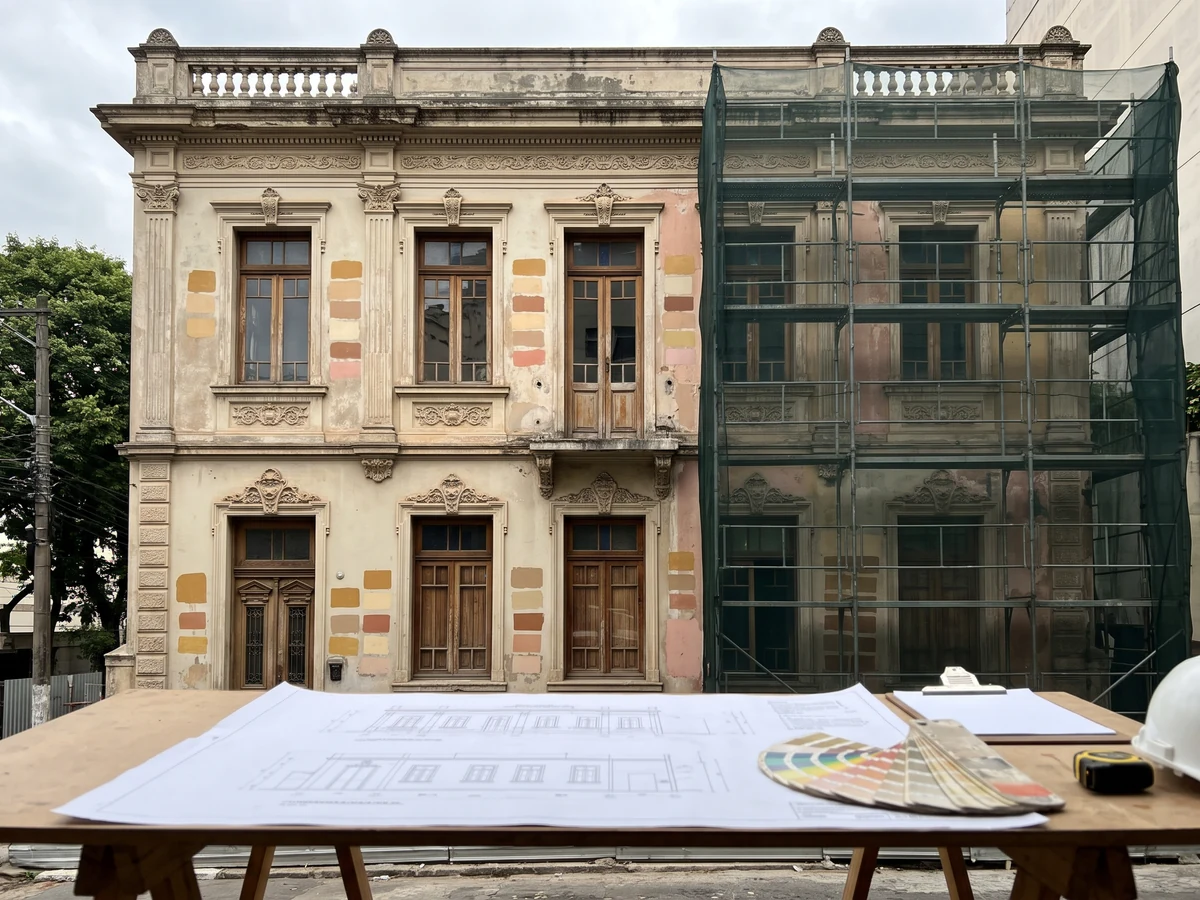
Protection check, design with a technical manager and follow-up of the authorization at DPH/CONPRESP, CONDEPHAAT and IPHAN, to renovate, paint or restore with City Hall's permit in order.
Quick answer
Work on listed properties (CONPRESP, CONDEPHAAT and IPHAN) in São Paulo, in a few lines
In São Paulo, repairing, painting, renovating or restoring a listed property, or one under study for listing, requires prior authorization from the agency that protected it: DPH and CONPRESP in the city, CONDEPHAAT at the state level and IPHAN at the federal level. Work in the surrounding protected area (área envoltória), around the listed property, also goes through heritage review as a rule, and City Hall's permit depends on that approval. Work without authorization leads to a fine of 10% to 100% of the assessed value and the obligation to restore. MTC identifies the protection, prepares the design with a technical manager and follows the applications at the heritage agencies and City Hall.
Updated on by the MTC technical team, based on the rules cited on this page.
- Who authorizes in the city
- DPH and, in some cases, CONPRESP Source: São Paulo City Hall (DPH): work on protected cultural properties(opens in a new tab)
- Work without authorization
- Fine of 10% to 100% of the assessed value Source: Decree No. 47.493/2006, as amended by Decree No. 54.805/2014 (heritage fines)(opens in a new tab)
- Demolition of a listed property
- Prohibited; fine of 1 to 10 times the assessed value Source: Law No. 10.032/1985 (CONPRESP), arts. 20, 21, 31 and 34(opens in a new tab)
- IPHAN deadline
- Up to 45 days, or 60 for restoration Source: Ordinance IPHAN No. 289/2025 (authorization of interventions, replacing 420/2010)(opens in a new tab)
What authorization for work on a listed property is
A listed property is one that a preservation agency has protected for its historic, architectural or cultural value: CONPRESP in the city of São Paulo, CONDEPHAAT at the state level and IPHAN at the federal level. Under Law 10.032/1985, a listed property can only be repaired, painted, restored or altered with prior authorization from DPH and, when necessary, from CONPRESP. The same rule applies to a property under study for listing and, with its own rules, to the surroundings of the listed property, the surrounding protected area (área envoltória).
Work without authorization leads to a fine of 10% to 100% of the assessed value (valor venal) and the obligation to restore at the owner's own expense, with a daily fine until the restoration begins. Altering a protected building without authorization can also be a crime, punishable by 1 to 3 years of imprisonment, and the possessor, the technical manager and the contractor are liable along with the owner. Without the heritage agency's opinion, City Hall's permit is not issued: on a protected property, no work counts as low impact.
What can or cannot change depends on the listing resolution and the protection level of each property, and the same address may be subject to rules from more than one agency. MTC identifies the protection, reads the guidelines before the design, prepares the technical documents to each agency's standard, answers the requirements and coordinates the heritage authorization with City Hall's permit.
What MTC does
Protection check
CIT, GeoSampa, IDESP and IPHAN: who protects it and at what level.
Reading the resolution
What the work can change, before drawing up the design.
Design and technical documents
To each agency's standard, with RRTRRT (Technical Responsibility Record). The equivalent of the ART for architects, registered with the CAU. or ARTTechnical Responsibility Record (Anotação de Responsabilidade Técnica). A CREA record that identifies the engineer responsible for a project, technical report, or construction work..
Complete follow-up
“Comunique-se” notices, heritage authorization and permit.
Understand it in one image
From the protection check to approved work
- 1
Check
Who protects the property: city, state or federal government
- 2
Resolution
Protection level and what the work can change
- 3
Project
Technical documents with RRT or ART, to each agency's standard
- 4
Heritage
Authorization from DPH/CONPRESP, CONDEPHAAT or IPHAN
- 5
City Hall
Permit with the heritage agency's opinion; work cleared
Only in the surroundings of a listed property? Under Resolution 28/2013, a renovation that does not change the volume, built area or permeable area does not need CONPRESP consent; the state and federal levels have their own rules.
Before touching the property, four answers
They define the application and who decides.- 01 · ProtectionListed, under study or only in the surroundings
- 02 · AgencyCONPRESP, CONDEPHAAT, IPHAN or more than one
- 03 · LevelWhat the resolution requires to be preserved
- 04 · ConstructionRepair, renovation, restoration or demolition
What protection changes for each type of work
It is the first thing MTC reviews: the type of intervention defines the application, the documents and who decides.
| Intervention | What the rule requires |
|---|---|
| Repair, painting and maintenance | Prior authorization from the agency, even for painting |
| Replacing windows and doors | A separate application; changing the model, the material or the opening is treated as renovation |
| Interior renovation or expansion | Design approved by the heritage agency and a City Hall permit; the limit is the protection level |
| Restoration | Authorization from the agency; a permit is also needed if there are adaptations beyond the original |
| Change of use | Possible, if the adaptations preserve what led to the listing |
| Signboard or sign | In a listed neighborhood, only 1 identification sign of up to 1.50 m² |
| Parklet | In front of a listed property, prior consent from DPH/CONPRESP |
| Demolition | Prohibited on a listed property; in the surroundings, it depends on authorization |
| Renovation in the surroundings (surrounding protected area) | Without changing the volume, built area or permeable area, Resolution 28/2013 waives CONPRESP consent |
| Surroundings of a state or federal listed property | Design approved beforehand by CONDEPHAAT or IPHAN |
Each property follows the resolution that protected it, and the same address may be protected by more than one agency. MTC reads each agency's rules before the design.
Source: Law No. 10.032/1985 (CONPRESP), arts. 20, 21, 31 and 34(opens in a new tab)Why get authorization first
From fined work to work approved by the heritage agency
Each card shows a common problem. Tap a problem to see how it is solved.
What happens to work without authorization
DPH can inspect the listed property and indicate work to be done or undone. Each following stage weighs more heavily on your budget and on the work schedule.
- 1
Inspection and violation notice
The agency points out what was done without authorization and what must be undone.
What can be doneStop the work and apply for regularization.
- 2
Fine based on the assessed value
From 10% to 100% of the assessed value for a listed property; from 10% to 50% in the surroundings.
What can be doneRequest an agreement (TAC) before the fine, if the damage is reversible.
- 3
Mandatory restoration
The owner restores at their own expense, with a fine of at least 1% of the assessed value per day until it starts.
What can be doneA restoration design within DPH's guidelines.
- 4
Criminal action
Altering a protected building without authorization carries a penalty of 1 to 3 years of imprisonment.
What can be doneDefense with the client's lawyer; MTC takes care of the technical part.
Beyond the heritage agencies: where irregular work gets stuck
At City Hall
- Permit on holdWithout the heritage agency's opinion, there is no permit.
- Conditional regularizationEven the Amnesty depends on the agency's consent.
In business
- Shared liabilityThe possessor and the contractor are liable too.
- Sign on holdA sign on a protected property goes through the agency.
In finances
- Fine and restorationBoth can be required at the same time.
- TDC on holdWithout a good state of repair, there is no certificate.
Planning to renovate, paint or restore a protected property? Contact MTC before you start.
Chat on WhatsAppWhat an authorization in order brings
Work cleared
Work starts with authorization from the right agency.
Design within the resolution
Protection level checked beforehand.
Permit unblocked
Heritage agency and City Hall on the same design.
Preserved property
Facade and protected elements in order.
Sale and lease
Property with nothing pending at the heritage agencies.
Path to the TDC
Good state of repair, required for the certificate.
When it is needed
- Renovating a house, shop or office in a listed property
- Work on a property next to a listed property
- Facade painting, or window or roof replacement
- Sign, awning or parklet on a protected property
- Change of use of a listed property
- Notice, fine or work stopped by the heritage agency
Documents that help you get started
You do not need all of them. The team will tell you what is missing.
- Updated property record
- IPTU bill, with the taxpayer number
- Owner's or company documents
- Current photos of the property and the facade
- Old plans or approved design, if any
- Condominium meeting minutes, if the work is in a common area
How we handle your case
- 1
Protection check
Who protects the property and at what level.
- 2
Reading the resolution
What the work can change and what it preserves.
- 3
Project
Survey, technical documents and RRT or ART.
- 4
Heritage application
DPH/CONPRESP, CONDEPHAAT or IPHAN, with “Comunique-se” notices.
Work approved
Heritage authorization and City Hall's permit in order.
- Work only starts with the heritage authorization and, when required, the permit.
- A property under study for listing has the same restrictions as a listed one.
- Each agency that protects the property reviews its own application.
- An application with incomplete documentation is not reviewed.
Questions about work on listed properties (CONPRESP, CONDEPHAAT and IPHAN)
The questions that come to the team and show up in searches most often, with the answer and the source.
See all questionsYes, but only with prior authorization. Under Law 10.032/1985, a listed property can only be repaired, painted, restored or altered with authorization from DPH and, when necessary, from CONPRESP. A property under study for listing follows the same regime, and what the work can change depends on the protection level. If the work needs a permit, City Hall only decides after the heritage agency.
Source: Law No. 10.032/1985 (CONPRESP), arts. 20, 21, 31 and 34 (opens in a new tab)In the city, the check is done with the IPTU taxpayer number in the Registry of Listed Properties (Cadastro de Imóveis Tombados, CIT) or on GeoSampa, and the IPTU bill also shows the protection. The state shows the properties it protects and their surrounding protected areas on the IDESP map. Since the same property can be protected by more than one agency, all three levels must be checked.
Source: São Paulo City Hall (DPH): how to find out if a property is listed (opens in a new tab)It is the area around the listed property, defined in the listing resolution, where work follows rules that protect the visibility and the setting of the property. In the city, work in the surrounding protected area goes through DPH/CONPRESP, but Resolution 28/2013 waives consent for renovations that do not change the volume, built area or permeable area. Breaking the rules for the surroundings leads to a fine of 10% to 50% of the assessed value of the land.
Source: Resolution CONPRESP No. 28/2013 (renovations in the surrounding protected area without prior consent) (opens in a new tab)They are preservation levels used in CONPRESP resolutions. In the Bela Vista resolution, for example, NP1 preserves the whole property, outside and inside; NP2 preserves the entire exterior and, sometimes, interior parts; and NP3 keeps the external features and the harmony with protected neighbors. Each resolution defines its own levels, so reading it comes before the design.
Source: Resolution CONPRESP No. 22/2002 (Bela Vista), art. 7: levels NP1, NP2 and NP3 (opens in a new tab)Only with prior authorization: the law includes painting among the interventions that depend on the heritage agency. Under IPHAN's rule, replacing window and door frames with others of the same model and material is a simplified renovation; changing the model, the material or the opening is a renovation. In the municipal fine, facade frames and finishes count as affected elements.
Source: Ordinance IPHAN No. 289/2025 (authorization of interventions, replacing 420/2010) (opens in a new tab)In the city, from 10% to 100% of the assessed value, depending on severity, and from 10% to 50% when the violation is in the surroundings. The owner also has to restore the property at their own expense, with a fine of at least 1% of the assessed value per day until the restoration begins. The possessor, the technical manager and the contractor are liable along with the owner.
Source: Law No. 10.032/1985 (CONPRESP), arts. 20, 21, 31 and 34 (opens in a new tab)No. Law 10.032/1985 prohibits destroying, demolishing or mutilating a listed property, with a fine of 1 to 10 times the assessed value and an obligation to rebuild. Destroying or altering a protected building without authorization is also a crime, punishable by 1 to 3 years of imprisonment and a fine. In the surroundings, demolishing a property that is not listed depends on authorization from the agency.
Source: Law No. 9.605/1998, arts. 62 to 64 (crimes against cultural heritage) (opens in a new tab)There is no single deadline. Resolution 06/2001 gives DPH up to 45 days for the technical opinion, extendable when information is missing, and some cases also go to a Council meeting. An application with incomplete documentation is not reviewed. At IPHAN, Ordinance 289/2025 provides for up to 45 days, or 60 for restoration.
Source: Resolution CONPRESP No. 06/2001 (authorization by DPH and CONPRESP) (opens in a new tab)Legal basis and sources
- Law No. 10.032/1985 (CONPRESP), arts. 20, 21, 31 and 34(opens in a new tab)
- Decree No. 47.493/2006, as amended by Decree No. 54.805/2014 (heritage fines)(opens in a new tab)
- Resolution CONPRESP No. 28/2013 (renovations in the surrounding protected area without prior consent)(opens in a new tab)
- Building Code (Código de Obras e Edificações), Law No. 16.642/2017(opens in a new tab)
- State Decree No. 13.426/1979, art. 134 (CONDEPHAAT authorization)(opens in a new tab)
- Decree-Law No. 25/1937 (federal listing), arts. 17 and 18(opens in a new tab)
- Ordinance IPHAN No. 289/2025 (authorization of interventions, replacing 420/2010)(opens in a new tab)
- Resolution CONPRESP No. 01/2007 (signs in listed heritage areas)(opens in a new tab)
Informational content, reviewed on November 11, 2026. The rules may change; the analysis of each case considers the rule in force on the date of the application. MTC is a private company, not affiliated with government agencies.
Related services
- Construction, renovation and demolition permitDesign, technical responsibility and follow-up of the Approval Permit and the Construction Permit at City Hall, so the work starts in compliance and ends with the Habite-se.See service
- Property regularizationTechnical analysis, project design, and follow-up so that the property is consistent with City Hall and with the property record at the registry office.See service
- Business sign license (CADAN)Sign measurements within the Clean City Law (Lei Cidade Limpa), technical responsibility and the license application at the Subprefeitura, so your facade shows your name without the risk of a fine.See service