
Lots and urban planning · City Hall and registry office
Lot or land split
Division of a lot into two or more areas, with a project, City Hall approval and the opening of the new property records.
Quick answer
Lot or land split in São Paulo, in a few lines
A lot split (desdobro) is the division of one lot into two or more. In São Paulo, each new lot must have at least 125 m² and 5 m of frontage, or more, depending on the zone (Law 16.402/2016). The permit is requested at the Subprefecture, is valid for 1 year and must be recorded at the registry office within that period, with a separate property record (matrícula) for each part. The IPTU (property tax) is split separately, at the Finance Department (Secretaria da Fazenda).
Updated on by the MTC technical team, based on the rules cited on this page.
- Minimum lot in the city
- 125 m² and 5 m of frontage (larger in some zones) Source: Zoning Law, Law No. 16.402/2016 (Table 2A)(opens in a new tab)
- Permit validity
- 1 year to record at the registry office Source: Decree No. 57.558/2016 (land subdivision)(opens in a new tab)
- Fee
- 0.15% of the UFM (municipal fiscal unit) per square meter Source: SP156: lot split or subdivision(opens in a new tab)
What a lot split is
A lot split (desdobro) is the division of one lot into two or more smaller lots, each with its own property record (matrícula) at the registry office and its own IPTU registration.
It is common in families that divided the land among siblings, in owners who want to sell a part, or in people who plan to build independent houses. Often the division already exists on the wall, but not in the documents.
It is only possible when the new lots meet the zoning rules on minimum size, frontage and access. MTC checks feasibility before any project.
What MTC does
Feasibility study
We check whether the lot can be divided and how.
Topographic survey
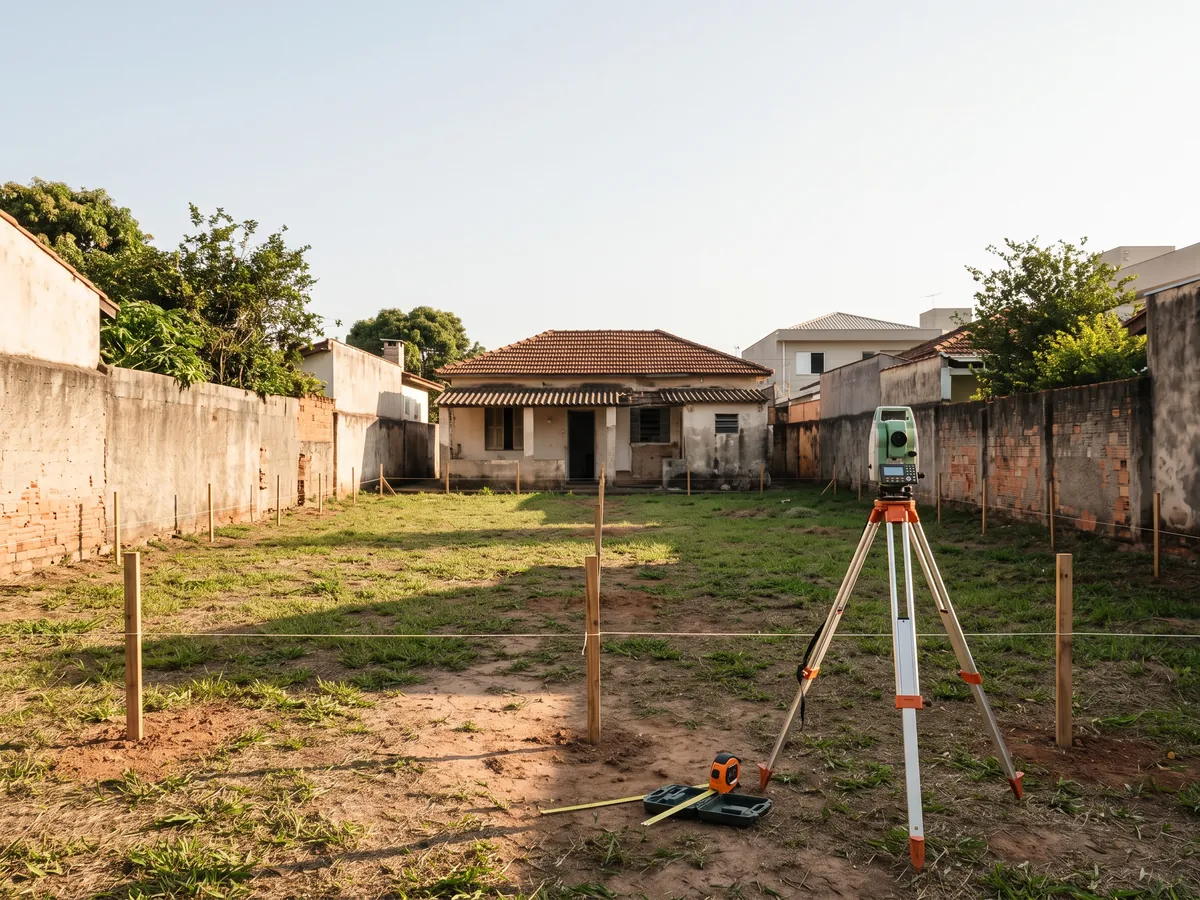
Measurement of the land and of the existing buildings.
Lot split project
Technical drawings for approval at City Hall.
New property records
Follow-up at the registry office until recording.
Understand it in one image
How one lot becomes two
- 1Each new lot must have the minimum frontage and area for its zone: in most of the city, 5 m and 125 m².
- 2The subdivision permit is requested at the Subprefecture and is valid for 1 year.
- 3With the permit, the registry office opens a property record for each lot.
- 4Finally, the IPTU is split at the Finance Department (DIC-D Desdobro).
What each new lot needs
Without these four points, the lot is not recognized.- 01 · Minimum areaArea required by zoning
- 02 · FrontageMinimum frontage on the public road
- 03 · AccessOwn entrance from the street
- 04 · Property recordOwn registration at the registry office
Minimum lot by zone in São Paulo
The first test of a lot split is the measurements: each resulting lot must meet the minimum frontage and area of the zone it is in. The figures below are from Table 2A of the Zoning Law.
| Zone | Minimum frontage | Minimum area |
|---|---|---|
| ZM, ZC, ZEIS, ZPR, ZER-2 and ZDE-1 | Minimum frontage:5 m | Minimum area:125 m² |
| ZER-1 and ZCOR | Minimum frontage:10 m | Minimum area:250 m² |
| ZERa | Minimum frontage:10 m | Minimum area:500 m² |
| ZEU, ZEM and ZPDS | Minimum frontage:20 m | Minimum area:1,000 m² |
| ZPI-1 and ZDE-2 | Minimum frontage:10 m | Minimum area:1,000 m² |
| ZPI-2 | Minimum frontage:20 m | Minimum area:5,000 m² |
| ZEPAM | Minimum frontage:20 m | Minimum area:5,000 m² (20,000 m² in some macro-areas) |
Lots proven to have existed with smaller dimensions can be regularized if they meet the other parameters (art. 41 of Law 16.402/2016). The lot's zone appears in GeoSampa.
Source: Zoning Law, Law No. 16.402/2016 (Table 2A)(opens in a new tab)Why do a lot split
From land divided on the wall to a lot with its own property record
Each card shows a common problem. Tap a problem to see how it is solved.
What happens without a formal lot split
The informal division seems to solve things at first. The problems appear when someone wants to sell, finance or build, or when an estate inventory comes up. If the lot meets the zoning rules, the division can still be formalized.
- 1
Informal division
The land is divided on the wall or by contract, without a lot split.
What can be doneCarry out the feasibility study and the topographic survey.
- 2
Sale or inheritance blocked
The registry office does not record the sale of a part that has no property record of its own.
What can be doneGet the lot split approved at City Hall before the deed.
- 3
Irregular building
Work done on each part cannot get approval.
What can be doneRegularize the buildings together with the lot split, when possible.
- 4
Conflict between the parties
Disagreements over boundaries and use lead to disputes.
What can be doneDefine the boundaries through a technical survey and formalize them at the registry office.
While the lot is not divided on paper
When selling or financing
- Buyer without securityA portion without its own property record gives no security.
- Bank refusesA portion of land does not work as collateral.
In the use of the land
- Stalled constructionEach part cannot get its building approved.
- Shared IPTUOne tax bill for several occupants.
In the family's assets
- Co-owned inheritanceHeirs share the same land.
- DisputesUndefined boundaries cause conflicts.
Land divided only on the wall? Check whether a lot split is possible.
Chat on WhatsAppWhat a lot split brings to the land
Independent property records
Each lot with its own registration and owner.
Added value
Smaller, regularized lots tend to be in higher demand.
Liquidity
Each part can be sold independently.
Access to credit
Each lot can be financed.
Fair division
Inheritance divided with legal certainty.
Separate IPTU
Each owner is responsible for their own tax.
When it is needed
- Sale of part of the land
- Inheritance with more than one heir
- Building independent houses
- A division that already exists in practice
- Investment planning
Documents that help you get started
You do not need all of them. The team will tell you what is missing.
- Up-to-date property record of the lot
- Property IPTU
- Existing plan or survey
- Owners' documents
- Plans of existing buildings, if there are any
How we handle your case
- 1
Feasibility
Rules on minimum size, frontage and access.
- 2
Survey
Topography and existing buildings.
- 3
Project
Technical drawings and ART.
- 4
Approval
Filing and review at City Hall.
Registration
Opening of the new property records at the registry office.
- The new lots must meet the minimum zoning dimensions.
- Existing buildings may need to be regularized first.
- There are City Hall and registry office costs.
Questions about lot or land split
The questions that come to the team and show up in searches most often, with the answer and the source.
See all questionsYou request the subdivision permit (alvará de desmembramento) at the Subprefecture, in person. With the permit, the registry office opens a property record for each resulting part.
Source: SP156: lot split or subdivision (opens in a new tab)In São Paulo, in practice, yes. The 2016 Zoning Law no longer uses the name desdobro: the division of a lot or piece of land, without opening new streets, is requested as a subdivision (desmembramento). That is why the City Hall document is called a Subdivision Permit (Alvará de Desmembramento).
Source: Zoning Law, Law No. 16.402/2016 (Table 2A) (opens in a new tab)The minimum lot area in the city is 125 m², with 5 m of frontage. Some zones require more: in ZER-1, for example, it is 10 m of frontage and 250 m².
Source: Zoning Law, Law No. 16.402/2016 (Table 2A) (opens in a new tab)Not necessarily. A lot with a building on it can be subdivided if the resulting lots meet the zone's indices, but this does not apply to an irregular building, which must be regularized first.
Source: Decree No. 57.558/2016 (land subdivision) (opens in a new tab)City Hall indicates up to 180 days for the review, a period that can be extended. After that, the permit is valid for 1 year for recording at the registry office.
Source: SP156: lot split or subdivision (opens in a new tab)0.15% of the UFM (municipal fiscal unit) per square meter. The amount in reais depends on the UFM for the year.
Source: SP156: lot split or subdivision (opens in a new tab)Up-to-date proof of ownership, IPTU, a plan of the current and the intended situation, a descriptive memorial and proof that the buildings are in order. In watershed protection areas or historic heritage areas, the responsible agencies issue an opinion.
Source: SP156: lot split or subdivision (opens in a new tab)No. The lot split is done at the Subprefecture and at the registry office. The tax split, which separates the IPTU, is requested at the Finance Department through the DIC-D Desdobro service.
Source: São Paulo City Hall (Finance): change of lot in the IPTU (DIC-D) (opens in a new tab)It can, if it is proven that the lot already existed with those measurements and if it meets the other parameters of the law.
Source: Zoning Law, Law No. 16.402/2016 (Table 2A) (opens in a new tab)Legal basis and sources
- Zoning Law, Law No. 16.402/2016 (Table 2A)(opens in a new tab)
- Decree No. 57.558/2016 (land subdivision)(opens in a new tab)
- SP156: lot split or subdivision(opens in a new tab)
- Public Records Law, Law No. 6.015/1973(opens in a new tab)
Informational content, reviewed on October 23, 2026. The rules may change; the analysis of each case considers the rule in force on the date of the application. MTC is a private company, with no affiliation with public agencies.
Related services
- Lot mergerMerging two or more neighboring lots into one, with documentation, a project and follow-up at City Hall and at the registry office.See service
- Registry office casesRecordings on the property record (averbações), registrations, property records (matrículas), deeds, and corrections at property registry offices (cartórios).See service
- Property regularizationTechnical analysis, project design, and follow-up so that the property is consistent with City Hall and with the property record at the registry office.See service